Split digraphs worksheet for Year 1: Magic e
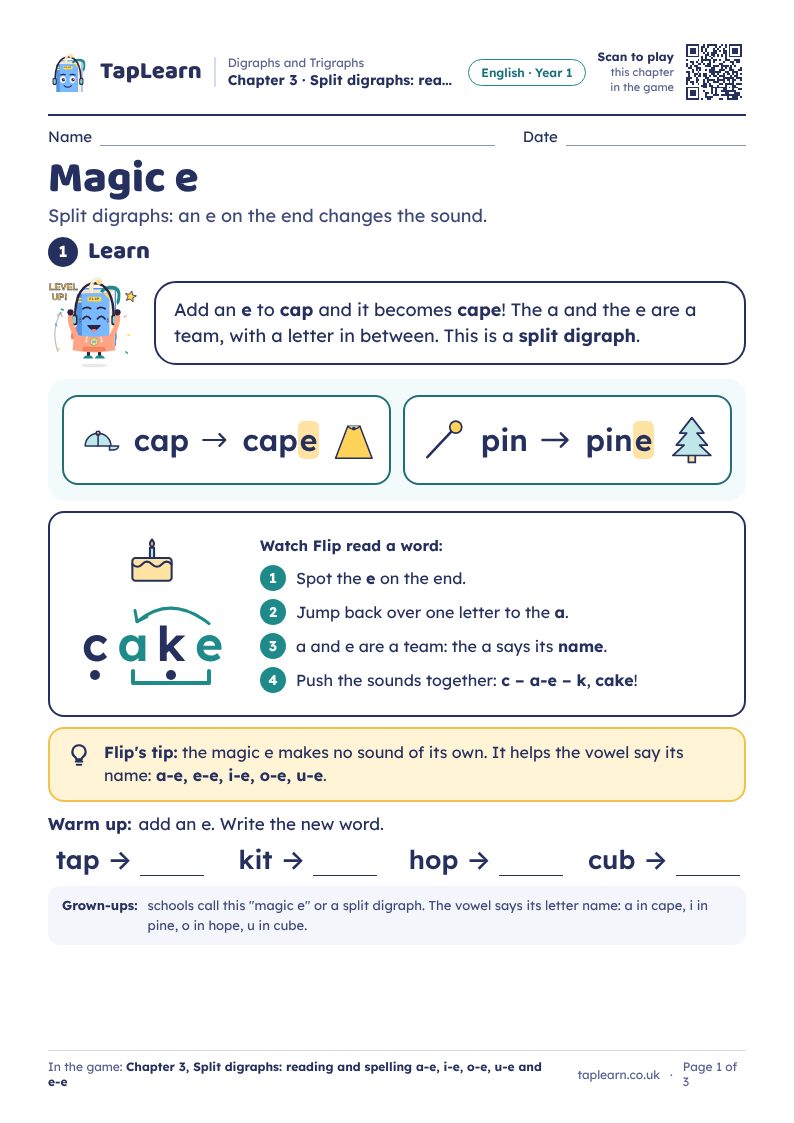
Magic e is a printable split digraphs worksheet for Year 1 (ages 5 to 6) that teaches children that an e on the end makes a team with the vowel, so the vowel says its name: cap becomes cape. It covers the Year 1 statements on responding speedily with the correct sound to graphemes and spelling words containing each of the 40+ phonemes already taught.
This worksheet is for members
Membership opens every chapter of every game and every worksheet, for all your children.
See the plansAlready a member? Log in to print it.
Start with the free one: Letter teams (chapter 1).
▶ Play chapter 3 in the game · How the split digraphs (magic e) works
Print it on A4, in colour or black and white. Do it after the chapter, or before it to see what your child already knows.
What's on the worksheet
Your child reads and spells split digraph (magic e) words like cape, kite, bone and cube, and sees how adding e turns cap into cape. Includes a magic e card activity and an answers sheet.
- Page 1 · Learn
- Cap and cape, pin and pine, Flip reading cake by jumping from the e back to the a, the tip that magic e makes no sound itself, and an add-an-e warm-up.
- Page 2 · Try it together
- Magic e card: write cap, pin, cub, hop and kit on a strip, put an e card on the end of each and read the new word, then spell cake by tapping the sounds.
- Page 3 · Practise
- Pick the word that matches each picture, write the two missing letters, draw a jump from the e to its partner in words like these and June, and a challenge about cape.
- Answers sheet
- Every answer, mix-ups like reading cape as cap, and a magic e trick and name-or-sound idea.
3 A4 pages and an answers sheet · about 20 minutes
Using it at home
- Schools call this "magic e" or a split digraph. The vowel says its letter name: a in cape, i in pine, o in hope, u in cube.
- If your child reads cape as cap, cover the e, read cap, then uncover it and say, "The e is here, so a says its name."
- Say a short word like hat, pip or not and ask your child to "add an e" out loud (hate, pipe, note).
Watch out for
- Reading the short vowel, like cape as cap.
- Point to the e and ask, "What does the e tell the a to do?"
- Forgetting the e when spelling, like cak for cake.
- Say the word, tap the sounds, then ask, "Which sound needs a split team?"
- Sounding out the e at the end, like cak-uh.
- The e is silent; it only changes the vowel.
Questions from the worksheet
- Draw a ring round the word that matches the picture: cap or cape, pine or pin, cub or cube, kite or kit.
- Draw a jump from the e back to its team partner, then read the word: these, home, June, made, five, rule.
- Mia reads the word cape as cap. Is she right? What does the e do?
The answers are on the answers sheet, for grown-ups.
National curriculum in England
This worksheet practises these statements from the Year 1 english programme of study:
- Respond speedily with the correct sound to graphemes (letters or groups of letters) for all 40+ phonemes, including, where applicable, alternative sounds for graphemes
- Spell: words containing each of the 40+ phonemes already taught
In the classroom
- Use a big magic e card at the front: pupils read each word before and after the e is added.
- Use Practise C with arrows drawn on mini whiteboards.
Questions and answers
What is a split digraph?
A split digraph is two vowel letters that make one sound with a letter in between, like a-e in cake. Schools often call it magic e.
What does magic e do?
Magic e makes no sound of its own. It helps the vowel before it say its name, so cap becomes cape and pin becomes pine.
Which split digraphs do Year 1 children learn?
Year 1 children learn a-e, e-e, i-e, o-e and u-e, as in cake, these, kite, home and cube.
More worksheets from Digraphs and Trigraphs: A Letter Teams Island Adventure
- Chapter 1: Vowel digraphs worksheet: Letter teams Free
- Chapter 2: Trigraphs worksheet: More letter teams Members
- Chapter 4: Alternative sounds worksheet: Two sounds Members
- Chapter 5: Ai and ay, oi and oy worksheet: ai or ay? Members
- Chapter 6: Spelling digraphs worksheet: Sound it, spell it Members
 TapLearn