Vowel digraphs worksheet for Year 1: Letter teams
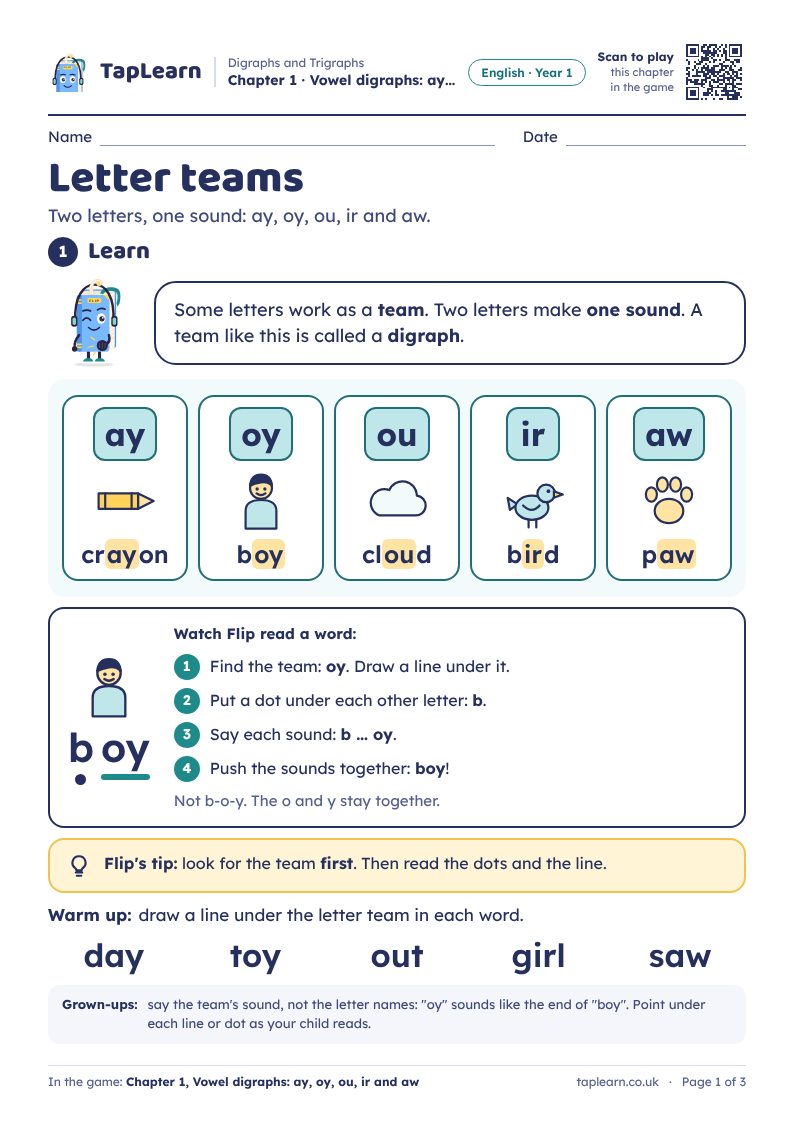
Letter Teams is a printable vowel digraphs worksheet for Year 1 (ages 5 to 6) that teaches children to spot two letters making one sound, ay, oy, ou, ir and aw, and read words like boy, cloud and bird. It covers the Year 1 statement on responding speedily with the correct sound to graphemes (letters or groups of letters).
Free to print, no account needed.
Print it on A4, in colour or black and white. Do it after the chapter, or before it to see what your child already knows.
What's on the worksheet
Your child reads the vowel digraphs ay, oy, ou, ir and aw as one sound in words like boy, cloud and bird, using a line under the team and dots under other letters. Includes a sound hunt around the room and an answers sheet.
- Page 1 · Learn
- What a digraph is, the five teams with picture words, Flip reading boy step by step with a line under the team and a dot under b, and a find-the-team warm-up.
- Page 2 · Try it together
- Sound hunt: write ay, oy, ou, ir and aw on sticky notes around the room; the grown-up says a word, the child finds the matching team, says it and thinks of another word.
- Page 3 · Practise
- Ring the team and read the word, write the missing team for each picture, read cloud and bird and draw them, pick the word that matches each picture, and a challenge about boy.
- Answers sheet
- Every answer, mix-ups like reading b-o-y, and I-spy-a-team and silly-sentence ideas.
3 A4 pages and an answers sheet · about 20 minutes
In the classroom
- Use the warm-up as a phonics starter: children underline the team on mini whiteboards.
- Run the sound hunt as a group game with team cards around the classroom.
Questions from the worksheet
- Draw a ring round the letter team in each word. Then read the word: house, shirt, saw, tray, toy.
- Read the word. Draw it in the box: cloud, bird.
- Leo reads the word boy as b – o – y. Is he right? How should he read it?
The answers are on the answers sheet, for grown-ups.
National curriculum in England
This worksheet practises this statement from the Year 1 english programme of study:
- Respond speedily with the correct sound to graphemes (letters or groups of letters) for all 40+ phonemes, including, where applicable, alternative sounds for graphemes
Using it at home
- Say the team's sound, not the letter names: oy sounds like the end of boy. Point under each line or dot as your child reads.
- In the sound hunt, good words to say are day, play, toy, out, shout, girl, first, saw and claw.
- Play I spy a team: "I spy something with ou in it" (cloud, mouse, house).
Watch out for
- Reading each letter on its own, like b-o-y.
- Cover the word and show just the team, say its sound, then uncover the rest.
- Mixing up teams, such as oy and ou.
- Use a picture word for each: oy as in boy, ou as in cloud.
- Saying letter names instead of sounds.
- Model the pure sound, then blend.
Questions and answers
What is a vowel digraph?
A vowel digraph is two letters that make one vowel sound, like ay in day, oy in boy, ou in cloud, ir in bird and aw in paw.
Why does my child read boy as b-o-y?
They are sounding each letter on its own. Show them that o and y are a team: draw a line under oy, then read b – oy.
When do children learn ay, oy, ou, ir and aw?
These vowel digraphs are usually taught in Year 1, when children learn more ways to write each sound.
 TapLearn