Translation worksheet for Year 4: Moving points
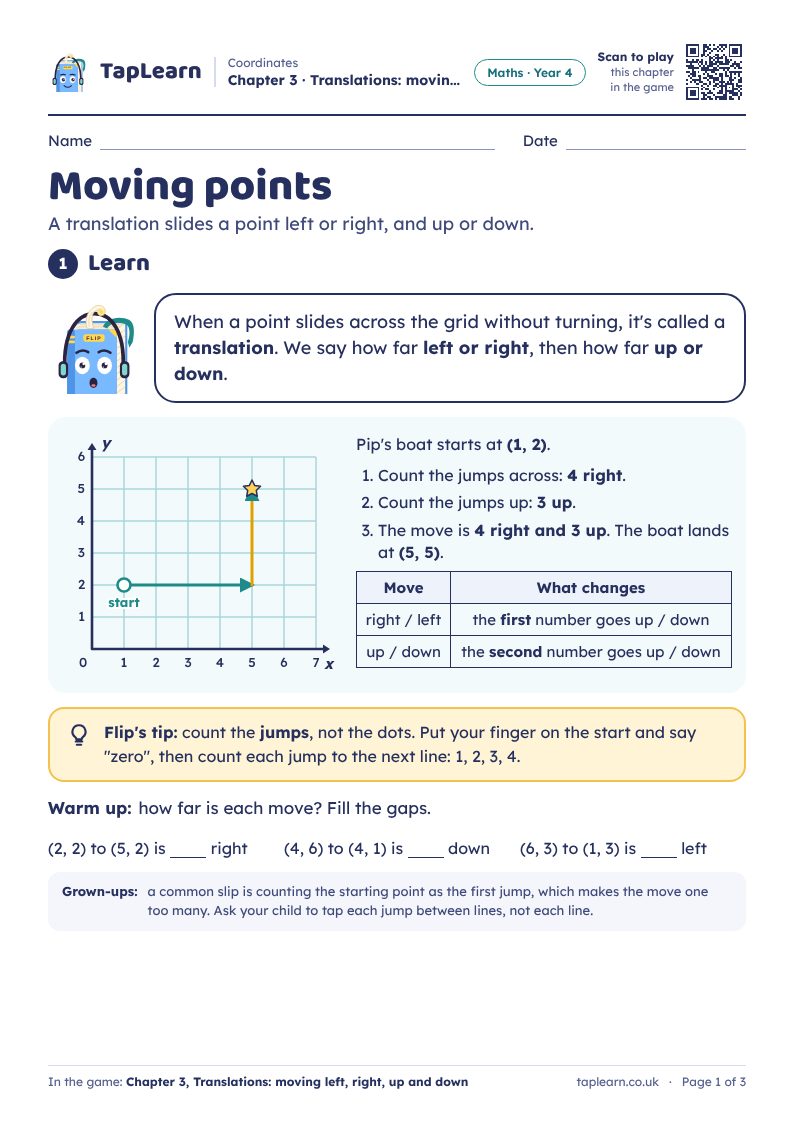
Moving Points is a printable translation worksheet for Year 4 (ages 8 to 9) that teaches children to describe a move as left or right and up or down, and work out where a point lands. It covers the Year 4 maths statement to describe movements between positions as translations of a given unit to the left/right and up/down.
This worksheet is for members
Membership opens every chapter of every game and every worksheet, for all your children.
See the plansAlready a member? Log in to print it.
Start with the free one: Reading coordinates (chapter 1).
Print it on A4, in colour or black and white. Do it after the chapter, or before it to see what your child already knows.
What's on the worksheet
Your child describes a move on a grid as a translation, such as 3 right and 2 up, and works out a point's new coordinates after it moves. Includes a toy-on-the-move activity and an answers sheet.
- Page 1 · Learn
- Pip's boat moves 4 right and 3 up from (1, 2) to (5, 5), a table of which number changes, Flip's count-the-jumps tip, and a how-far warm-up.
- Page 2 · Try it together
- Toy on the move: place a toy on a grid, the grown-up calls a move like 2 right and 3 up, and the child predicts the landing point before sliding the toy to check. Then describe moves.
- Page 3 · Practise
- Work out where five points land after moves, follow Pip's three-move route to the treasure, and a challenge about (3, 2) moving 2 up.
- Answers sheet
- Every answer, mix-ups like counting the start as a jump or changing the wrong number, and robot walk and guess-my-move games.
3 A4 pages and an answers sheet · about 25 minutes
In the classroom
- Play robot walk on a floor grid, with children giving translations to a partner.
- Use Practise B as a mini-whiteboard check, predicting each landing point.
Questions from the worksheet
- Where does each point land? (6, 5) moves 2 left and 1 down → ( , )
- (0, 4) moves 3 right and 2 up → ( , )
- Follow Pip's route to the treasure. Start at (1, 1). Move 1: 3 right and 2 up.
- Ava says, "(3, 2) moves 2 up, so it lands at (5, 2)." Is she right? Explain.
The answers are on the answers sheet, for grown-ups.
National curriculum in England
This worksheet practises this statement from the Year 4 maths programme of study:
- Describe movements between positions as translations of a given unit to the left/right and up/down
Source: National curriculum in England: mathematics programmes of study (DfE)
Using it at home
- Ask your child to tap each jump between lines, not each line, so the starting point isn't counted.
- Before each move in toy on the move, ask "Which number will change?"
- On a tiled floor, give robot moves like "3 right, 2 forward" for your child to walk.
Watch out for
- Counting the start as a jump, so the move is one too many.
- Say "zero" on the start, then count each jump.
- Mixing up left and right, or up and down.
- Point in the direction before counting.
- Changing the wrong number, like the across number for an up move.
- Ask "Which number will change?" Left and right change the first; up and down change the second.
Questions and answers
What is a translation in maths?
A translation slides a shape or point across a grid without turning it. You describe it as how far left or right and how far up or down.
Which coordinate changes when a point moves up?
Moving up or down changes the second number. Moving left or right changes the first number.
Where does (3, 2) land after moving 2 up?
It lands at (3, 4). The up move adds 2 to the second number.
 TapLearn