Reading coordinates worksheet for Year 4
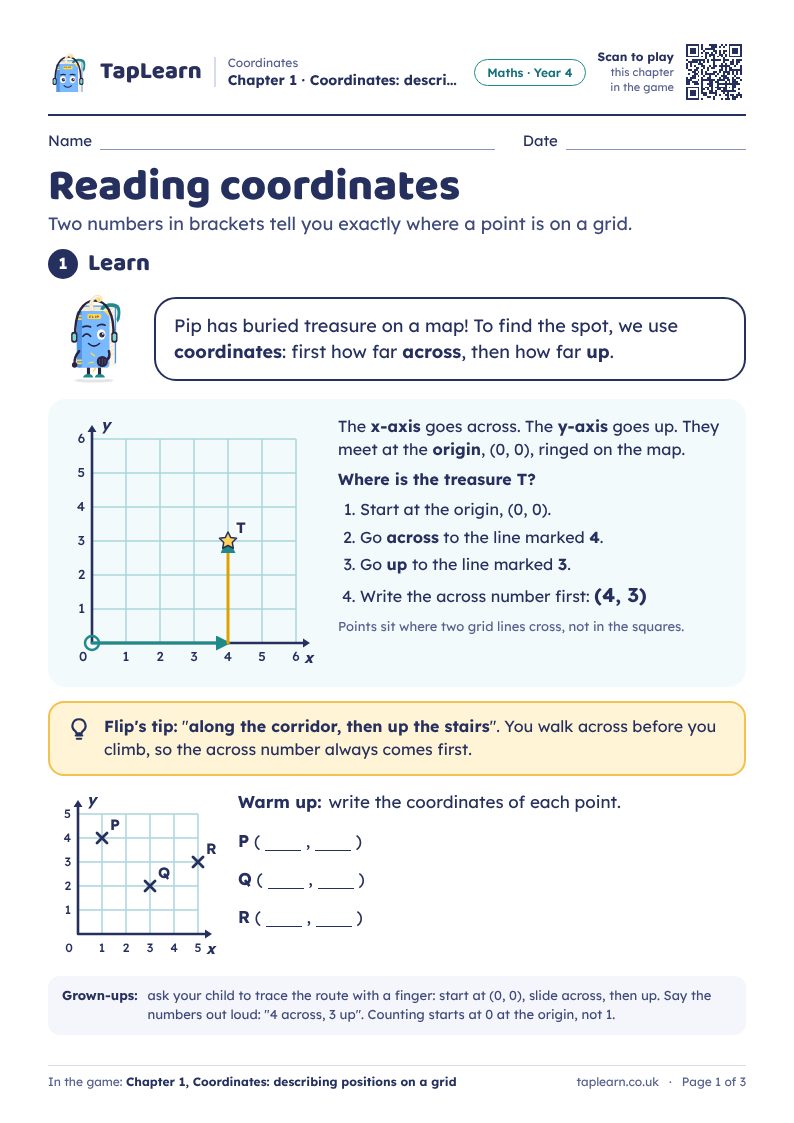
Reading Coordinates is a printable reading coordinates worksheet for Year 4 (ages 8 to 9) that teaches children to name the axes and origin and read a point's position as coordinates, across first and then up. It covers the Year 4 maths statement to describe positions on a 2-D grid as coordinates in the first quadrant.
Free to print, no account needed.
Print it on A4, in colour or black and white. Do it after the chapter, or before it to see what your child already knows.
What's on the worksheet
Your child names the x-axis, y-axis and origin, then reads the position of points on a grid as coordinates, across first and then up. Includes a hide-the-treasure game and an answers sheet.
- Page 1 · Learn
- A treasure map grid labels the x-axis, y-axis and origin, with a worked example finding treasure at (4, 3), Flip's along-the-corridor tip, and a warm-up.
- Page 2 · Try it together
- Hide the treasure: the grown-up puts a button where two grid lines cross, and the child says its coordinates and checks by tracing the route. Swap, with a deliberate mistake to catch.
- Page 3 · Practise
- Write the coordinates of points on Pip's map, ring the right coordinates for harder points including the origin, decode a secret word, and a challenge about point K.
- Answers sheet
- Every answer, mix-ups like counting from 1 at the origin, and tile hunt and mystery point games.
3 A4 pages and an answers sheet · about 25 minutes
In the classroom
- Use mystery point as a starter: "3 across and 5 up" and children write the coordinates.
- Play hide the treasure in pairs on mini-whiteboard grids.
Questions from the worksheet
- Write the coordinates of each point on Pip's map.
- Draw a ring round the right coordinates for the point where the axes meet: (1, 1), (0, 0) or (0, 1).
- Secret word! Find the letter at each pair of coordinates. Where does Pip keep the treasure?
- Leo says point K is at (4, 2). Is he right? Explain how you know.
The answers are on the answers sheet, for grown-ups.
National curriculum in England
This worksheet practises this statement from the Year 4 maths programme of study:
- Describe positions on a 2-D grid as coordinates in the first quadrant
Source: National curriculum in England: mathematics programmes of study (DfE)
Using it at home
- Ask your child to trace the route with a finger from (0, 0), across then up, saying "4 across, 3 up".
- Try a hide-the-treasure round with the treasure on an axis, like (0, 5): the 0 means no steps that way.
- On a tiled floor or chessboard, pick a corner as (0, 0) and name where things are.
Watch out for
- Writing the numbers the wrong way round, like (5, 3) for (3, 5).
- Say "along the corridor, then up the stairs" and trace the route with a finger.
- Counting from 1 at the origin, so each number is one too big.
- The origin is (0, 0): count the lines you move to, starting from 0.
- Counting squares instead of lines.
- Points sit where lines cross. Read the number printed on the line.
Questions and answers
How do you read coordinates?
Start at the origin (0, 0), go across to the first number, then up to the second. Write the across number first, like (4, 3).
What is the origin on a grid?
The origin is where the x-axis and y-axis meet. Its coordinates are (0, 0).
Why does the across number come first?
It's the rule for coordinates. A tip is "along the corridor, then up the stairs": you walk across before you climb.
 TapLearn