Plotting coordinates worksheet for Year 4: Plotting points
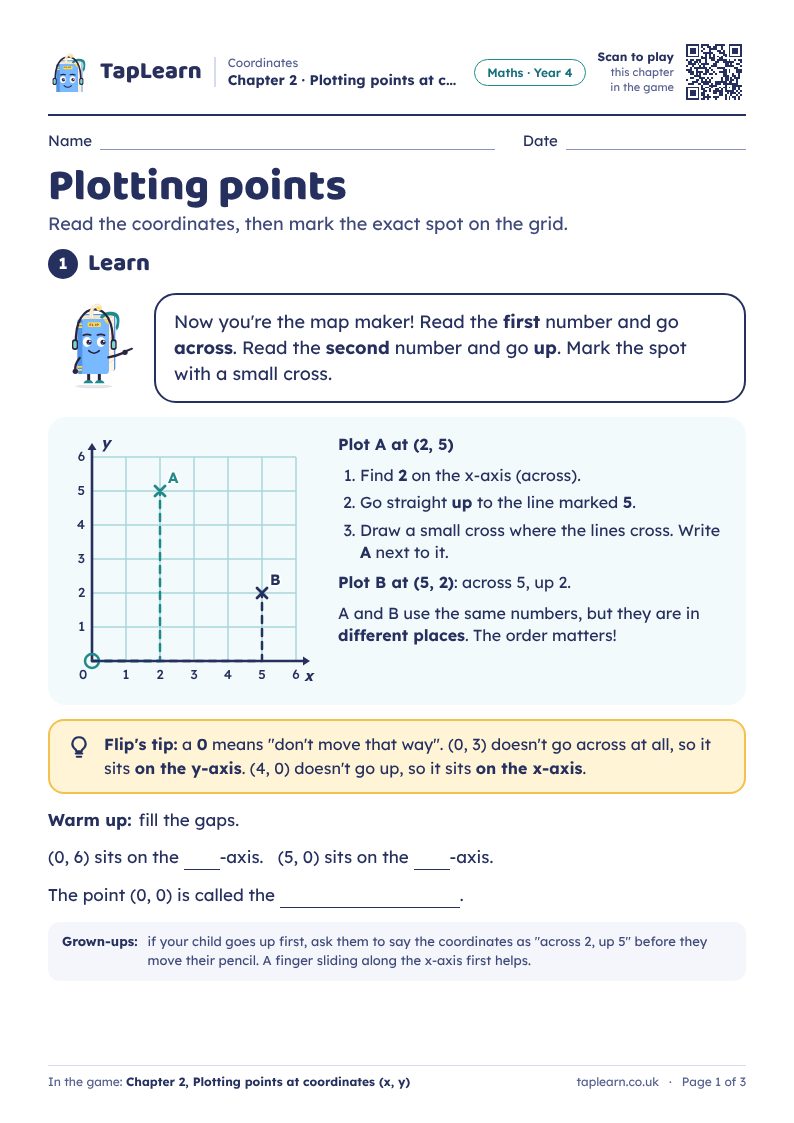
Plotting Points is a printable plotting coordinates worksheet for Year 4 (ages 8 to 9) that teaches children to mark points at given coordinates, including points on an axis. It covers the Year 4 maths statements to describe positions on a 2-D grid as coordinates and plot specified points.
This worksheet is for members
Membership opens every chapter of every game and every worksheet, for all your children.
See the plansAlready a member? Log in to print it.
Start with the free one: Reading coordinates (chapter 1).
Print it on A4, in colour or black and white. Do it after the chapter, or before it to see what your child already knows.
What's on the worksheet
Your child plots points at given coordinates, including points that sit on an axis, and spots points plotted the wrong way round. Includes a hidden boats game and an answers sheet.
- Page 1 · Learn
- A worked example plotting A at (2, 5) and B at (5, 2) to show the order matters, Flip's tip on points with a 0, and an axes and origin warm-up.
- Page 2 · Try it together
- Hidden boats: draw 0 to 5 grids, secretly plot 3 boats each behind a book, then take turns calling coordinates to find each other's boats. Then plot six points.
- Page 3 · Practise
- Plot points and join them to make a picture, check Mia's plotted points and fix the wrong ones, and a challenge about (0, 4) and (4, 0).
- Answers sheet
- Every answer including Mia's mistakes, mix-ups like going up first, and finger plotting and mistake spotting ideas.
3 A4 pages and an answers sheet · about 25 minutes
Using it at home
- If your child goes up first, ask them to say "across 2, up 5" before they move their pencil.
- In hidden boats, put one of your boats on an axis, like (0, 3), and ask "across first or up first?" when your child calls.
- Plot a point the wrong way round on purpose and let your child correct you.
Watch out for
- Going up first, so the point lands in the wrong place.
- Say "across, then up" and slide a finger along the x-axis before going up.
- Counting the origin as 1, so the point lands one short.
- The origin is 0: count the lines you move to.
- Plotting points with a 0, like (0, 3), in the middle of the grid.
- A 0 means no move that way, so the point sits on an axis.
Questions from the worksheet
- Plot each point with a small cross and write its letter next to it: A (2, 3), E (4, 0), F (0, 2).
- Plot these points and join them in order with a ruler. What picture do you make?
- Mia was asked to plot P (1, 4), Q (5, 2), R (3, 0) and S (4, 4). Tick the points she got right and plot the wrong ones in the right place.
- Sam says, "(0, 4) and (4, 0) are the same point, because they both use 0 and 4." Is he right? Explain.
The answers are on the answers sheet, for grown-ups.
National curriculum in England
This worksheet practises these statements from the Year 4 maths programme of study:
- Describe positions on a 2-D grid as coordinates in the first quadrant
- Plot specified points and draw sides to complete a given polygon
Source: National curriculum in England: mathematics programmes of study (DfE)
In the classroom
- Play hidden boats in pairs, then discuss any boats that were hard to find because of a mix-up.
- Use finger plotting on a floor grid: call coordinates and a child walks to the spot.
Questions and answers
How do you plot a point on a grid?
Read the first number and go across, then read the second number and go up. Mark the spot with a small cross where the lines meet.
Where does (0, 4) go on a grid?
(0, 4) doesn't go across at all, so it sits on the y-axis, 4 up.
Are (2, 5) and (5, 2) the same point?
No. (2, 5) is 2 across and 5 up; (5, 2) is 5 across and 2 up. The order matters.
 TapLearn