What you'll learn
- What an algorithm is: a list of steps in the right order
- Why changing the order of steps changes what happens
- Why robots need precise, unambiguous instructions because they cannot guess
- That a program is an algorithm a digital device can follow
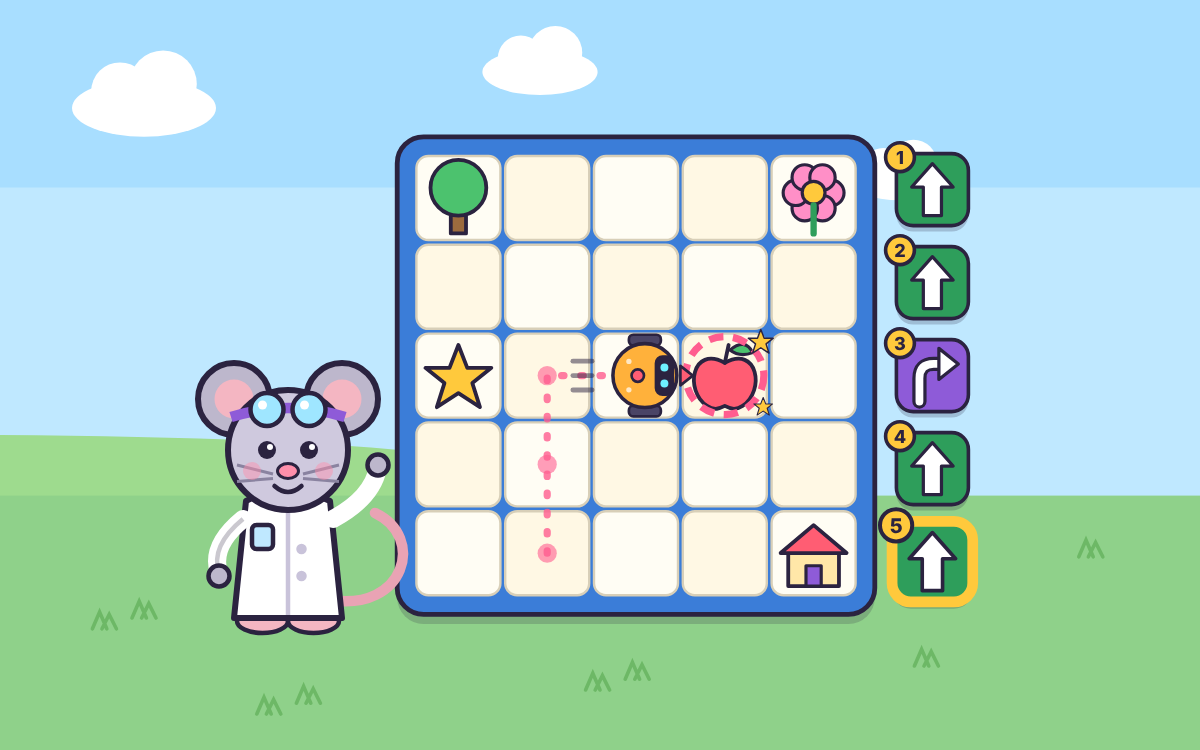
- How to predict where a floor robot will stop
- How to use logical reasoning to predict what a program does next
Chapter by chapter
- What is an algorithm? Steps in the right order Free to try
Years 1–2 computing · 1
- Precise and unambiguous instructions: robots can't guess
Years 1–2 computing · 1
- Programs on digital devices: turning an algorithm into a program
Years 1–2 computing · 1
- Predicting where a robot's program will take it
Years 1–2 computing · 2
- Using logical reasoning to predict what simple programs do
Years 1–2 computing · 2 Years 1–2 computing · 1
- Algorithm Expert Challenge (10 questions)
What the chapters cover in the national curriculum in England:
- Years 1–2 computing: Understand what algorithms are; how they are implemented as programs on digital devices; and that programs execute by following precise and unambiguous instructions
- Years 1–2 computing: Use logical reasoning to predict the behaviour of simple programs
About this adventure
Algorithms for Kids is an interactive game that teaches children aged 5 to 7 what an algorithm is, how algorithms become programs on digital devices, and how to predict what a simple program will do. It follows the KS1 computing curriculum in England and is pitched mainly at Year 1.
With Pip the mouse inventor, children tap everyday steps into order, watch a robot chef put a whole jar of jam on the bread, and choose instructions that are precise (exact) and unambiguous (with only one meaning). They press a floor robot's buttons to turn an algorithm into a program, then use logical reasoning, thinking one step at a time, to say where the robot will stop before pressing Go to check.
Every line is read aloud with captions, wrong answers get a helpful hint and a second try, and a final challenge checks what they have learned.
Questions and answers
What is an algorithm, in simple words?
An algorithm is a list of steps, in the right order, that tells someone or something how to do a job. Brushing your teeth or making a jam sandwich can be written as an algorithm, and computers follow algorithms too.
What is the difference between an algorithm and a program?
A program is an algorithm written in a form that a digital device can follow, such as button presses for a floor robot or code for a tablet. The algorithm is the plan, and the program is that plan turned into instructions the device can run.
Why do computers need precise and unambiguous instructions?
Computers and robots cannot guess what we mean, so they do exactly what they are told. A precise instruction is exact, like 'move forward 3 squares', and an unambiguous one has only one meaning, like 'pick up the blue cup' when there are two cups.
What age is this algorithms game for?
The game is for children aged 5 to 7, and it is pitched mainly at Year 1, when algorithms are usually first taught in KS1 computing in England. Everything is spoken aloud, so children who are still learning to read can play.
What does the algorithms game include and how long does it take?
It has five short chapters and a 10-question final challenge, and takes about 35 minutes to play from start to finish. There is also an optional left and right warm-up, and children can start any chapter from the Robo Town map.
More to explore
See all
If and Else in Coding: Make Choices with Bit the Robot
Learn how if and else let a program make choices, then build, run, predict and debug block programs with Bit…
Debugging Simple Programs: A Bug Hunt with Beep
Learn debugging simple programs: build routes for Beep the garden robot, then test them, find the step that g…
Sequences and Loops: Code a Robot and Squash the Bugs
Learn how sequences and loops make programs work by coding Beep the robot across a grid, predicting his moves…
Variables in Coding: Build Scores and Timers with Bit
Learn how variables in coding store scores, timers and names, then use set, change, loops and if blocks to bu…
Animal Life Cycles: Grow a Frog, Butterfly, Robin and Rabbit
Learn how animal life cycles work by helping a frog, butterfly, robin and rabbit grow, from egg or birth to a…
Skeletons and Muscles: Build a Body with Skelly
Learn how skeletons and muscles work together: build a skeleton, test how bones protect you, and make an arm…
The Heart and Circulatory System: Ride with Rosie
Learn how the heart and circulatory system work, then guide Rosie the red blood cell round the body, build yo…
 TapLearn