Rounding to the nearest 10 worksheet for Year 4: Rounding to 10
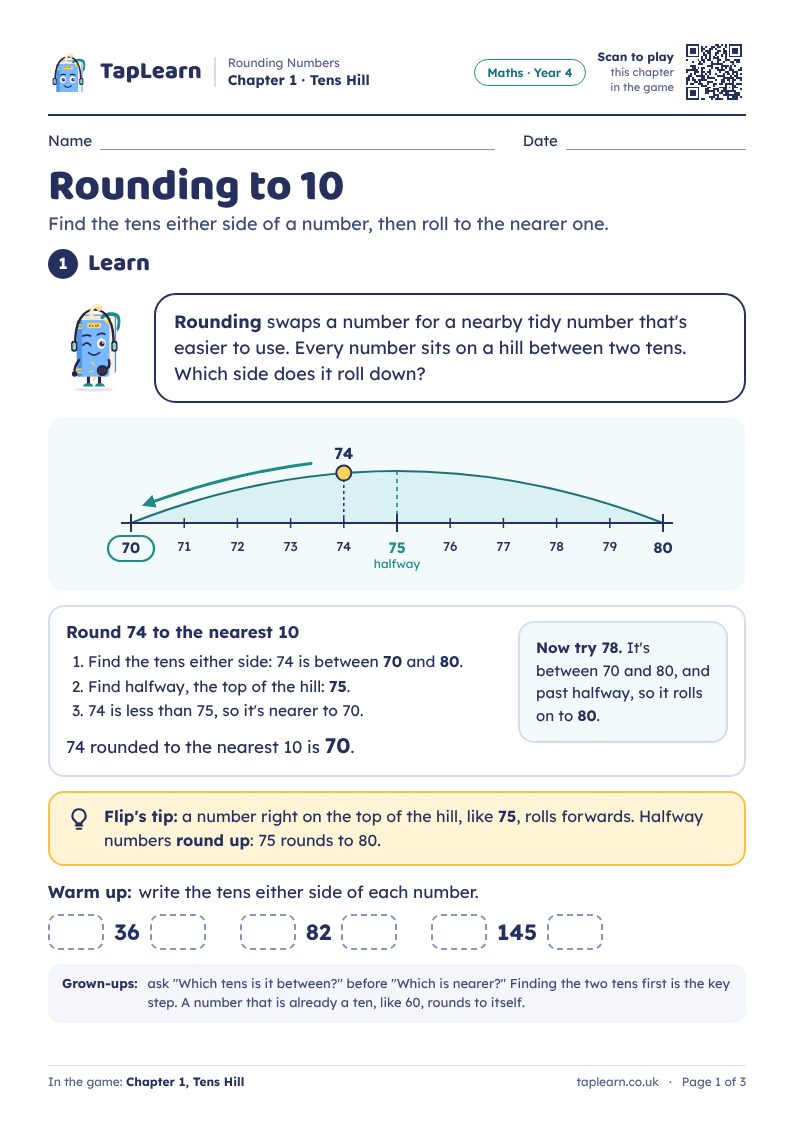
Rounding to 10 is a printable rounding to the nearest 10 worksheet for Year 4 (ages 8 to 9) that teaches children to find the tens either side of a number, spot the halfway point and decide which ten is nearer. It covers the Year 4 maths statement to round any number to the nearest 10, 100 or 1,000.
Free to print, no account needed.
Print it on A4, in colour or black and white. Do it after the chapter, or before it to see what your child already knows.
What's on the worksheet
Your child finds the tens either side of a number, spots the halfway point and rounds to the nearest 10, including halfway numbers like 75. Includes a roll-down-the-hill number line activity and an answers sheet.
- Page 1 · Learn
- A number line hill from 70 to 80 with halfway at the top, a worked example rounding 74 to 70, Flip's tip that halfway numbers round up, and a tens-either-side warm-up.
- Page 2 · Try it together
- Roll down the hill: lay paper scraps 40 to 50 in a line with 45 on an upturned cup, say a number, place a button on it and say which ten it rolls to. Then make a hill from 130 to 140.
- Page 3 · Practise
- Place numbers on hills and round them, fill in a ten before and ten after table, ring numbers that round to 50, write numbers that round to 30, and a challenge about 65.
- Answers sheet
- Every answer, mix-ups like rounding 5 down or losing the hundreds, and house-number and about-how-much ideas.
3 A4 pages and an answers sheet · about 25 minutes
In the classroom
- Build a giant number line hill on the floor and have children stand on numbers, then step to the nearer ten.
- Use the Sam challenge as a talk partner question to agree why halfway numbers round up.
Questions from the worksheet
- Put a dot on the hill for each number. Then round it to the nearest 10: 32, 167, 2,455.
- Write three different numbers that round to 30.
- Sam says, "65 is exactly halfway between 60 and 70, so it can go either way. I'll round it to 60." Is Sam right? Explain.
The answers are on the answers sheet, for grown-ups.
National curriculum in England
This worksheet practises these statements from the Year 4 maths programme of study:
- Round any number to the nearest 10, 100 or 1,000
- Round decimals with 1 decimal place to the nearest whole number
Source: National curriculum in England: mathematics programmes of study (DfE)
Using it at home
- Ask "Which tens is it between?" before "Which is nearer?" Finding the two tens first is the key step.
- During the hill activity, say 45 at some point and ask "Which way now?" Halfway numbers roll forwards to 50.
- On a walk, round each door number you pass to the nearest 10.
Watch out for
- Rounding 5 down, so 45 becomes 40.
- On the top of the hill it rolls forwards: 5 rounds up, so 45 rounds to 50.
- Going the wrong way, so 74 becomes 80.
- Ask "Is 74 nearer 70 or 80?" and count the steps: 4 back, 6 on.
- Losing the hundreds, so 135 becomes 40.
- Bigger numbers keep their other digits: 135 is between 130 and 140.
Questions and answers
How do you round to the nearest 10?
Find the two tens the number sits between, then see which one it is nearer. 74 is between 70 and 80 and nearer 70, so it rounds to 70.
Does 5 round up or down?
Halfway numbers round up, so 75 rounds to 80 and 45 rounds to 50. Everyone uses the same rule so we all get the same answer.
What does a number that is already a ten round to?
It rounds to itself: 60 rounded to the nearest 10 is 60.
 TapLearn