Rainforest plant adaptations worksheet for Years 3–6: Clever rainforest plants
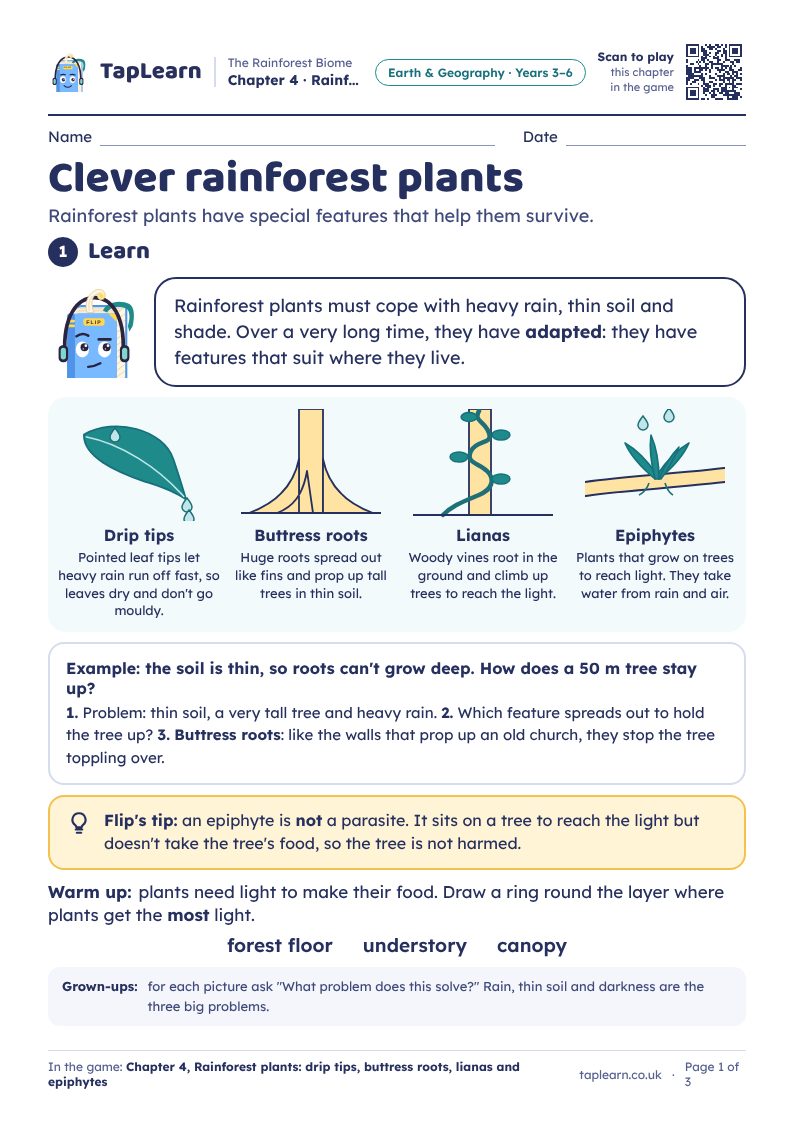
Clever Rainforest Plants is a printable rainforest plant adaptations worksheet for Years 3 to 6 (ages 7 to 11) that teaches how drip tips, buttress roots, lianas and epiphytes help plants survive heavy rain, thin soil and shade. It links to the KS2 national curriculum in England for geography: describe and understand key aspects of physical geography, including climate zones, biomes and vegetation belts.
This worksheet is for members
Membership opens every chapter of every game and every worksheet, for all your children.
See the plansAlready a member? Log in to print it.
Start with the free one: Finding rainforests (chapter 1).
Print it on A4, in colour or black and white. Do it after the chapter, or before it to see what your child already knows.
What's on the worksheet
Children explain how drip tips, buttress roots, lianas and epiphytes help rainforest plants survive heavy rain, thin soil and shade. Includes a hands-on drip tip test with foil leaves and an answers sheet.
- Page 1 · Learn
- Four pictures show drip tips, buttress roots, lianas and epiphytes with what each does, a worked example explains how a tall tree stays up in thin soil, and Flip explains that epiphytes are not parasites.
- Page 2 · Try it together
- Drip tip test: shape a round leaf and a pointed leaf from kitchen foil, pour a spoonful of water on each and see which sheds the water faster.
- Page 2–3 · Practise
- Match each feature to how it helps, design a rainforest plant with labelled features, fill gaps, sort true and false sentences and correct a mix-up about drip tips and roots.
- Answers sheet
- Every answer by page, notes on thinking epiphytes are parasites and mixing up drip tips and buttress roots, and a houseplant hunt.
3 A4 pages and an answers sheet · about 30 minutes
Using it at home
- Do the drip tip test over a tray or the sink, and let your child pour the water and describe what they see before you explain.
- For each picture on page 1, ask "What problem does this solve?": heavy rain, thin soil or darkness.
Watch out for
- Thinking epiphytes steal food from trees, like parasites.
- Explain that epiphytes only use the tree as a place to sit near the light; they take water from rain and air, not food from the tree.
- Mixing up what drip tips and buttress roots do.
- Tip is at the top: leaves shed rain. Roots are at the bottom: they hold the tall tree up in thin soil.
Questions from the worksheet
- Match each plant feature to how it helps: drip tips, buttress roots, lianas, epiphytes.
- Draw a plant you would design for the rainforest. Label two features and say how each one helps.
- True or false: epiphytes steal food from the tree they grow on.
- Ben says, "Drip tips help a tall tree stand up, and buttress roots help the leaves stay dry." Is Ben right?
The answers are on the answers sheet, for grown-ups.
National curriculum in England
This worksheet practises this statement from the Years 3–6 geography programme of study:
- Describe and understand key aspects of physical geography, including: climate zones, biomes and vegetation belts, rivers, mountains, volcanoes and earthquakes, and the water cycle
Source: National curriculum in England: geography programmes of study (DfE)
In the classroom
- Run the drip tip test as a group investigation, with each group recording which foil leaf sheds water faster.
- Use the design-a-plant task as a plenary: pupils explain their two features to a partner.
Questions and answers
What are drip tips on rainforest leaves?
Drip tips are pointed ends on leaves that let heavy rain run off quickly. The leaf dries fast, so it is lighter and less likely to grow mould.
Are epiphytes parasites?
No, epiphytes are not parasites. They grow on trees to reach the light, but get water from rain and the air and do not take food from the tree.
Why do rainforest trees have buttress roots?
Rainforest soil is thin, so roots spread out near the surface instead of growing deep. Big buttress roots spread out like fins to prop up very tall trees.
More worksheets from The Rainforest Biome: Explore the Layers with Tico
- Chapter 1: Where rainforests grow worksheet: Finding rainforests Free
- Chapter 2: Rainforest climate worksheet: Hot and wet all year Members
- Chapter 3: Rainforest layers worksheet: The four layers Members
- Chapter 5: Rainforest animals worksheet: Who lives where? Members
- Chapter 6: Why rainforests are important worksheet: Why rainforests matter Members
 TapLearn