Rainforest animals worksheet for Years 3–6: Who lives where?
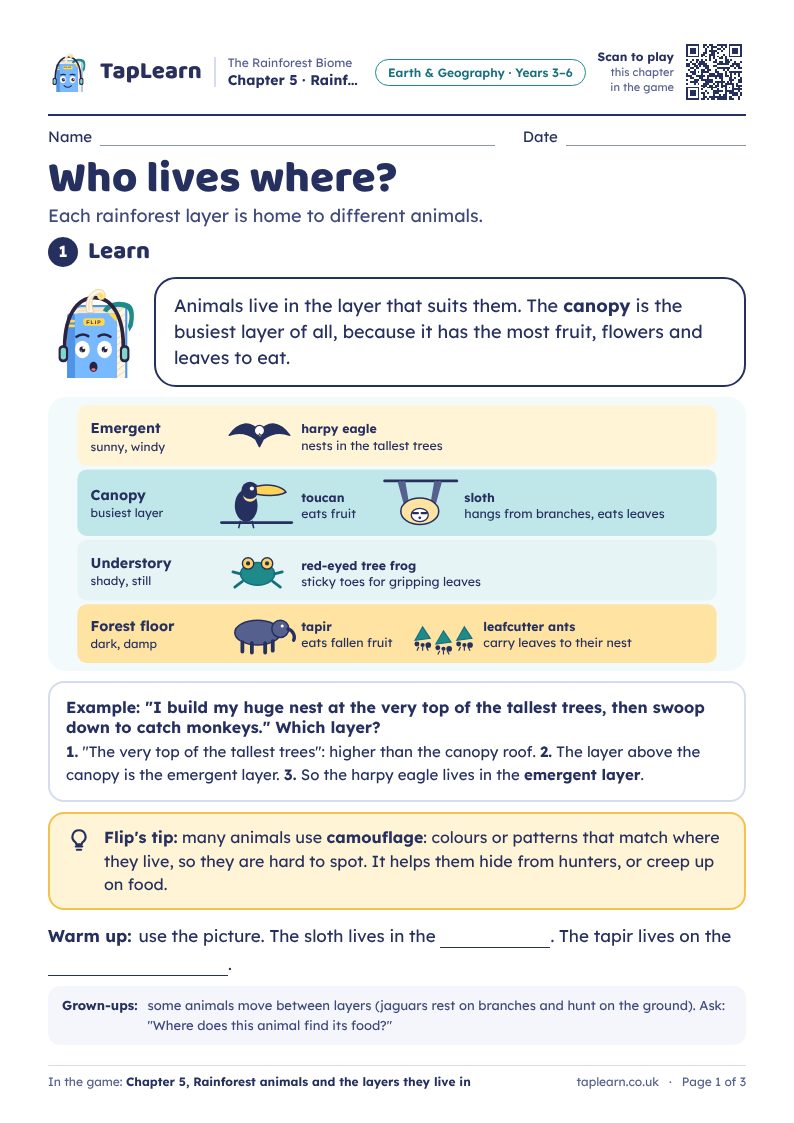
Who Lives Where? is a printable rainforest animals worksheet for Years 3 to 6 (ages 7 to 11) that teaches children to match animals to the layer they live in and explain why the canopy is the busiest layer. It links to the KS2 national curriculum in England for geography: describe and understand key aspects of physical geography, including climate zones, biomes and vegetation belts.
This worksheet is for members
Membership opens every chapter of every game and every worksheet, for all your children.
See the plansAlready a member? Log in to print it.
Start with the free one: Finding rainforests (chapter 1).
Print it on A4, in colour or black and white. Do it after the chapter, or before it to see what your child already knows.
What's on the worksheet
Children match rainforest animals such as the harpy eagle, toucan, sloth and tapir to the layer they live in, explain why the canopy is the busiest layer and how camouflage helps. Includes a camouflage bug hunt and answers.
- Page 1 · Learn
- A layered picture shows a harpy eagle, toucan, sloth, tree frog, tapir and leafcutter ants in their layers, a worked example finds the harpy eagle's layer, and Flip explains camouflage.
- Page 2 · Try it together
- Camouflage bug hunt: colour paper bugs to match a patterned cushion or in bright colours, hide them, and count which ones are found first.
- Page 2–3 · Practise
- Sort eight animals into the four layers, explain how a sloth's green fur hides it, tick why the canopy is busiest, draw an animal in its layer and correct a mistake about tapirs.
- Answers sheet
- Every answer by page, notes on mixing up animals that live high and low and on animals that move between layers, and guessing games.
3 A4 pages and an answers sheet · about 30 minutes
Using it at home
- Play the camouflage bug hunt twice, swapping who hides and who looks, and talk about which bugs a hungry bird would spot first.
- When your child sorts the animals, ask "Can it fly or climb? Where does it find its food?" rather than giving the answer.
Watch out for
- Mixing up animals that live high in the trees with ones that live near the ground.
- Ask whether the animal can fly or climb, and where it finds its food: a tapir eats fallen fruit on the floor, a toucan picks fruit in the canopy.
- Thinking each animal stays in one layer only.
- Explain that some animals move between layers: jaguars rest on branches and hunt on the ground.
Questions from the worksheet
- Write each animal in the layer it lives in: harpy eagle, toucan, sloth, spider monkey, red-eyed tree frog, tapir, leafcutter ants, giant anteater.
- A sloth moves slowly and green algae grow in its fur. How does this help it hide from a harpy eagle?
- Why is the canopy the busiest layer? Tick the three true reasons.
- Tom says, "Tapirs eat fruit, so they must live high up in the canopy." Is he right?
The answers are on the answers sheet, for grown-ups.
National curriculum in England
This worksheet practises this statement from the Years 3–6 geography programme of study:
- Describe and understand key aspects of physical geography, including: climate zones, biomes and vegetation belts, rivers, mountains, volcanoes and earthquakes, and the water cycle
Source: National curriculum in England: geography programmes of study (DfE)
In the classroom
- Give groups animal cards to place on a large four-layer wall display, explaining each choice.
- Use the camouflage bug hunt on a patterned display board, then discuss which colours were hardest to spot.
Questions and answers
Which animals live in the rainforest canopy?
The canopy is home to toucans, sloths, spider monkeys and many birds, insects and frogs. It is the busiest layer because it has the most fruit, flowers and leaves to eat.
How does camouflage help rainforest animals?
Camouflage means having colours or patterns that match where an animal lives. It helps animals hide from hunters, like a sloth with green algae in its fur, or creep up on food.
More worksheets from The Rainforest Biome: Explore the Layers with Tico
- Chapter 1: Where rainforests grow worksheet: Finding rainforests Free
- Chapter 2: Rainforest climate worksheet: Hot and wet all year Members
- Chapter 3: Rainforest layers worksheet: The four layers Members
- Chapter 4: Rainforest plant adaptations worksheet: Clever rainforest plants Members
- Chapter 6: Why rainforests are important worksheet: Why rainforests matter Members
 TapLearn