Prefixes and suffixes worksheet for Years 3–4: Building long words
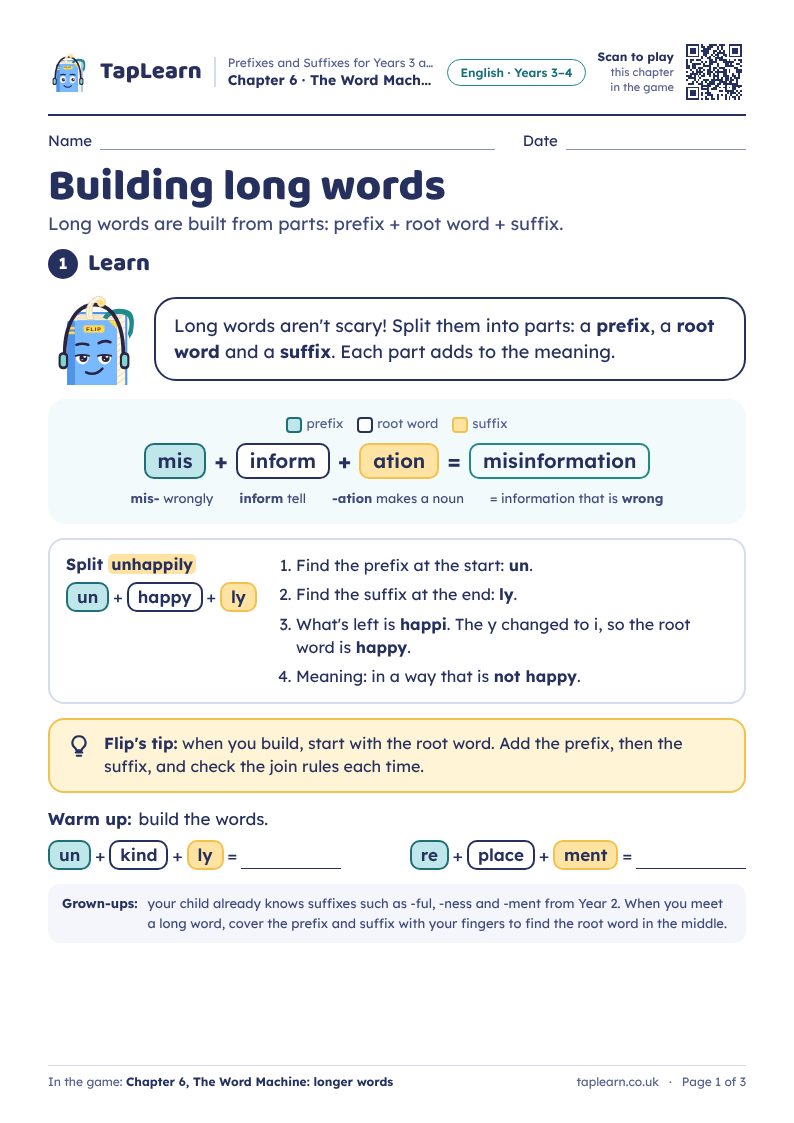
Building Long Words is a printable prefixes and suffixes worksheet for Years 3 and 4 (ages 7 to 9) that teaches children to split a long word into prefix, root word and suffix, and to use each part to work out its meaning. It covers the Years 3 to 4 statement on applying knowledge of root words, prefixes and suffixes to read aloud and understand new words.
This worksheet is for members
Membership opens every chapter of every game and every worksheet, for all your children.
See the plansAlready a member? Log in to print it.
Start with the free one: Un- and re- words (chapter 1).
Print it on A4, in colour or black and white. Do it after the chapter, or before it to see what your child already knows.
What's on the worksheet
Your child builds and splits longer words with a prefix, a root word and a suffix, such as misinformation and unhappily, keeping every letter at the joins. Includes a word machine card game and an answers sheet.
- Page 1 · Learn
- Misinformation built from mis + inform + ation, a worked example splitting unhappily, Flip's tip to start with the root word, and a build-the-words warm-up.
- Page 2 · Try it together
- The word machine: make prefix, root word and suffix cards, take turns building a word with one of each, say it aloud and explain what it means.
- Page 3 · Practise
- Split five words into three parts, build words while watching the joins, tick the right meaning for three words, build your own word, and a challenge about unusualy.
- Answers sheet
- Every answer, mix-ups like missing a part, and longest-word and reading-detective ideas.
3 A4 pages and an answers sheet · about 25 minutes
Using it at home
- When you meet a long word, cover the prefix and suffix with your fingers to find the root word in the middle.
- In the word machine, real words to aim for include unhelpful, unfairly, disagreement, misinformation and replacement.
- Take turns growing a word out loud: help, unhelpful, unhelpfully.
Watch out for
- Missing a part, like splitting unkindness into un + kindness.
- Ask, "Is the middle part the smallest root word you can find?"
- Dropping a letter at a join, like unusualy.
- Build one join at a time and keep every letter of each part.
- Forgetting the suffix rules.
- Remember y to i (uneasily) and drop the e before -ation (reorganisation).
Questions from the worksheet
- Split each word into prefix, root word and suffix: unhelpful, disagreement, unfairly, misleading, rebuilding.
- Build the word. Watch the joins! un + usual + ly, un + easy + ly, mis + spell + ing.
- What does it mean? misinformation: more information, wrong information or no information?
- Leo built un + usual + ly and wrote unusualy. Ava split unkindness into un + kindness. Who has made a mistake? Explain how to fix it.
The answers are on the answers sheet, for grown-ups.
National curriculum in England
This worksheet practises these statements from the Years 3–4 english programme of study:
- Apply their growing knowledge of root words, prefixes and suffixes (etymology and morphology) as listed in English appendix 1, both to read aloud and to understand the meaning of new words they meet
- Use further prefixes and suffixes and understand how to add them (English appendix 1)
- Word: formation of nouns using a range of prefixes (Year 3 english)
In the classroom
- Play the word machine in groups with colour-coded cards for prefixes, roots and suffixes.
- Split long words from a class book together before reading them.
Questions and answers
What are the parts of a long word?
Many long words have a prefix at the start, a root word in the middle and a suffix at the end, like un + help + ful.
How can splitting a word help with its meaning?
Each part adds meaning. In misinformation, mis- means wrongly, inform means tell and -ation makes a noun: information that is wrong.
What is a root word?
A root word is the main part of a word that prefixes and suffixes are added to, like help in unhelpful.
More worksheets from Prefixes and Suffixes for Years 3 and 4: Dot's Word Workshop
- Chapter 1: Prefixes un- and re- worksheet: Un- and re- words Free
- Chapter 2: Prefixes dis- and mis- worksheet: Dis- and mis- Members
- Chapter 3: Prefix sub- worksheet: Sub- means under Members
- Chapter 4: Suffix -ly worksheet: Adding -ly Members
- Chapter 5: Suffix -ation worksheet: Adding -ation Members
 TapLearn