Prefixes dis- and mis- worksheet for Years 3–4: Dis- and mis-
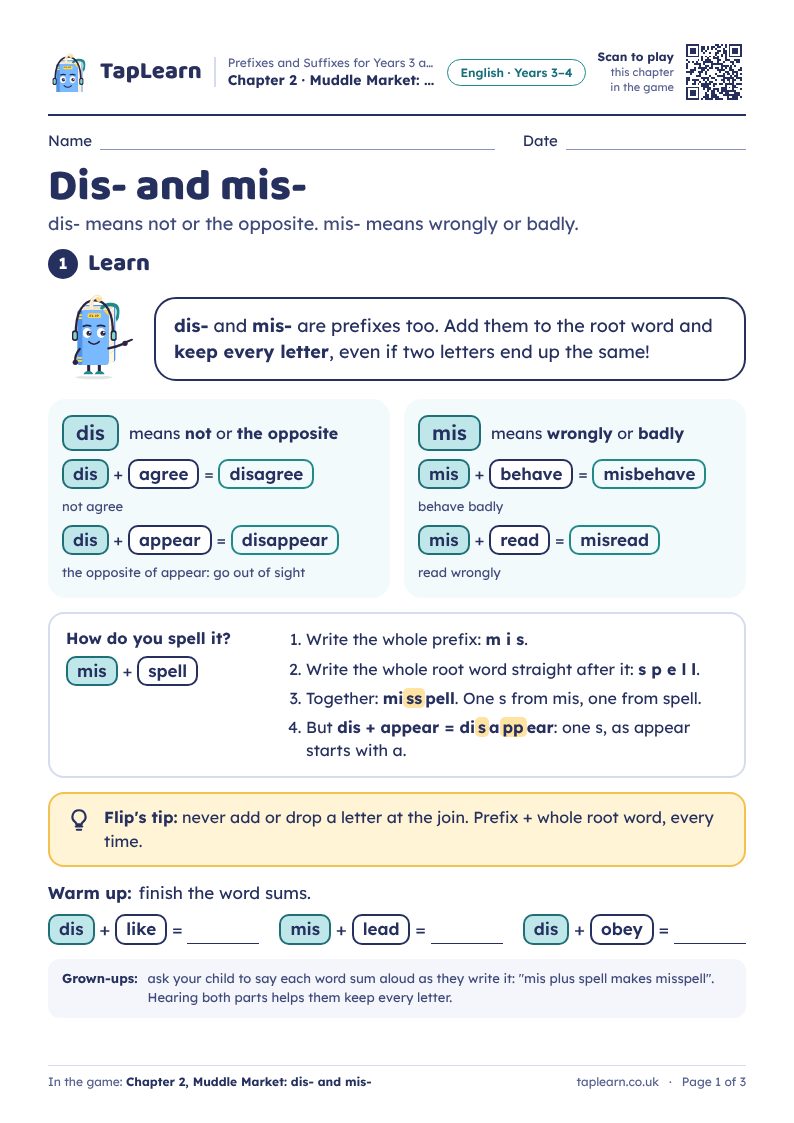
Dis- and Mis- is a printable prefixes dis- and mis- worksheet for Years 3 and 4 (ages 7 to 9) that teaches children that dis- means not or the opposite and mis- means wrongly, and to keep every letter at the join, as in misspell. It covers the Years 3 to 4 statements on using further prefixes and understanding how to add them, and using root words and prefixes to understand new words.
This worksheet is for members
Membership opens every chapter of every game and every worksheet, for all your children.
See the plansAlready a member? Log in to print it.
Start with the free one: Un- and re- words (chapter 1).
Print it on A4, in colour or black and white. Do it after the chapter, or before it to see what your child already knows.
What's on the worksheet
Your child uses dis- (not or the opposite) and mis- (wrongly) to change meanings, and spells words like misspell and disappear by keeping every letter at the join. Includes a muddle cards game and an answers sheet.
- Page 1 · Learn
- Dis- and mis- with example word sums, a worked example spelling misspell and disappear, Flip's tip never to add or drop a letter at the join, and a word sums warm-up.
- Page 2 · Try it together
- Muddle cards: write dis, mis and un on cards and root words like agree, behave and trust on others, try each prefix in front of a root and write the real words.
- Page 3 · Practise
- Ring the right prefix, fix spellings like unagree and mispell, write dis- or mis- words from meanings, finish sentences, write your own, and a challenge about misagree.
- Answers sheet
- Every answer, mix-ups like using un- for everything, and opposites-game and spell-it-aloud ideas.
3 A4 pages and an answers sheet · about 25 minutes
Using it at home
- Say the word sums aloud: "dis plus appear." Hearing both parts helps children keep every letter.
- In muddle cards, encourage your child to listen: our ears often know which prefix sounds right.
- Say "I like peas" and your child answers with dis-: "I dislike peas."
Watch out for
- Using un- for everything, like unagree or unhonest.
- Does it sound like a real word? Try dis-.
- Mixing up mis- and dis-.
- Ask, "Is it done wrongly (mis-), or is it not / the opposite (dis-)?"
- Dropping or adding a letter at the join, like mispell or dissappear.
- Write the prefix, then the whole root word: mis + spell, dis + appear.
Questions from the worksheet
- Draw a ring round the right prefix: dis or mis + agree, dis or mis + behave, dis or mis + understand.
- Spot the mistake. Write each word correctly: unagree, mispell, dissappear, unhonest.
- dis- or mis-? Write the word that matches the meaning: to read wrongly, to not trust, to go out of sight.
- Write dis or mis to finish each word: The magician made the rabbit ___appear into thin air.
- Leo wrote misagree to mean "not agree". He says dis- and mis- mean the same thing. Is he right? Explain the difference.
The answers are on the answers sheet, for grown-ups.
National curriculum in England
This worksheet practises these statements from the Years 3–4 english programme of study:
- Apply their growing knowledge of root words, prefixes and suffixes (etymology and morphology) as listed in English appendix 1, both to read aloud and to understand the meaning of new words they meet
- Use further prefixes and suffixes and understand how to add them (English appendix 1)
- Word: formation of nouns using a range of prefixes (Year 3 english)
In the classroom
- Play muddle cards in groups, recording real words in three columns.
- Ask pupils to spell misspell aloud and say where each s comes from.
Questions and answers
What does the prefix dis- mean?
Dis- means not or the opposite, as in disagree (not agree) and disappear (the opposite of appear).
What does the prefix mis- mean?
Mis- means wrongly or badly, as in misread (read wrongly) and misbehave (behave badly).
Why does misspell have two s's?
One s comes from mis and one from spell. Never drop a letter at the join.
More worksheets from Prefixes and Suffixes for Years 3 and 4: Dot's Word Workshop
- Chapter 1: Prefixes un- and re- worksheet: Un- and re- words Free
- Chapter 3: Prefix sub- worksheet: Sub- means under Members
- Chapter 4: Suffix -ly worksheet: Adding -ly Members
- Chapter 5: Suffix -ation worksheet: Adding -ation Members
- Chapter 6: Prefixes and suffixes worksheet: Building long words Members
 TapLearn