Plural and possessive s worksheet for Year 4: More than one, or belonging?
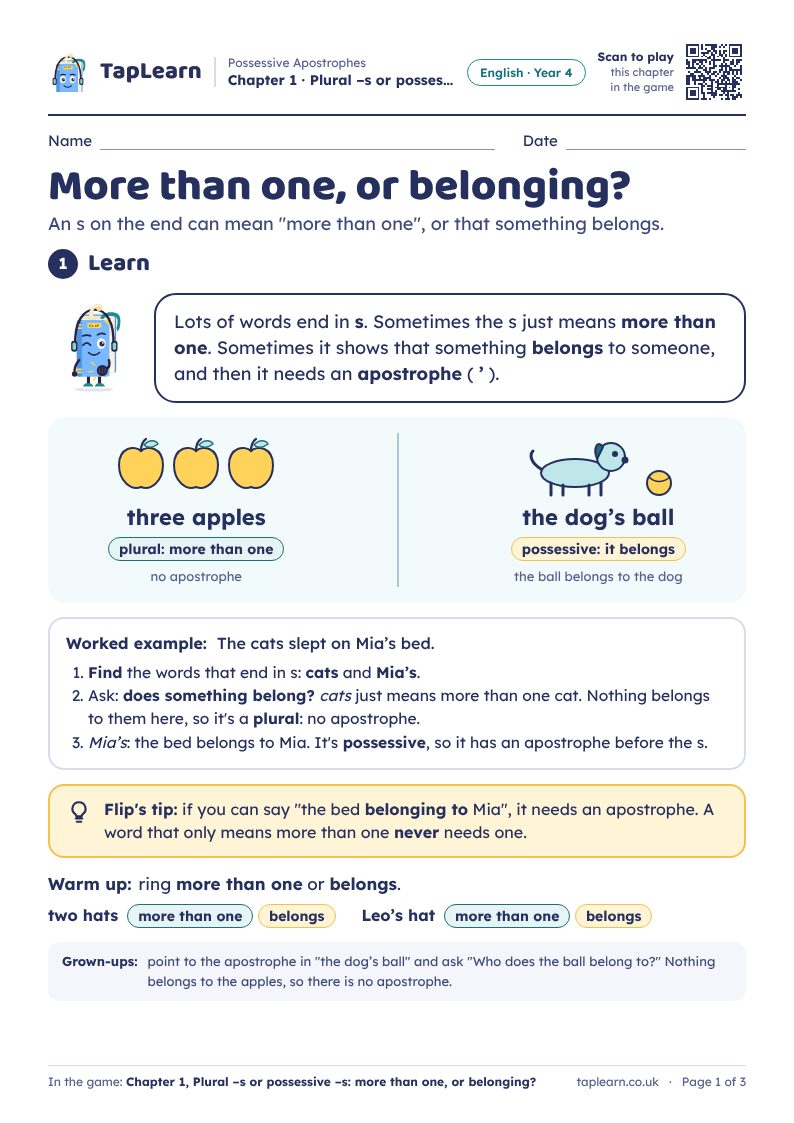
More Than One, or Belonging? is a printable plural and possessive s worksheet for Year 4 (ages 8 to 9) that teaches children to ask whether an s means more than one or shows that something belongs, as in three apples and the dog’s ball. It covers the Year 4 grammar statement on the grammatical difference between plural and possessive –s.
Free to print, no account needed.
Print it on A4, in colour or black and white. Do it after the chapter, or before it to see what your child already knows.
What's on the worksheet
Your child tells a plural s (more than one) from a possessive s (something belongs), and leaves apostrophes off plain plurals like apples. Includes an s-word hunt through books and packets and an answers sheet.
- Page 1 · Learn
- Three apples and the dog’s ball compared, a worked example sorting cats and Mia’s, Flip's "belonging to" test, and a more-than-one-or-belongs warm-up.
- Page 2 · Try it together
- S-word hunt: find 5 words ending in s in a storybook, comic, food packet or post, read each sentence, and decide whether the s means more than one or that something belongs.
- Page 3 · Practise
- Tick plural or possessive, ring the right word, fix four shop signs, write a plural and a possessive sentence about home, and a challenge about "my brother’s".
- Answers sheet
- Every answer, mix-ups like an apostrophe on every s, and thumbs-up and sign-spotting ideas.
3 A4 pages and an answers sheet · about 25 minutes
Using it at home
- Point to the apostrophe in "the dog’s ball" and ask "Who does the ball belong to?" Nothing belongs to the apples, so there is no apostrophe.
- In the s-word hunt, some words just happen to end in s, like bus, is or was. Skip those, or chat about why they're neither.
- On a walk or in a shop, look for signs with an s on the end. Is any apostrophe in the wrong place?
Watch out for
- Putting an apostrophe on every s, like apple’s for apples.
- If it only means more than one, it never gets an apostrophe. Real signs often get this wrong!
- Leaving the apostrophe out when something belongs, like Toms Café.
- Ask "Whose café is it?" If there's an answer, it needs an apostrophe.
Questions from the worksheet
- Is the underlined word plural or possessive? The frogs jumped into the pond. Sam’s kite is stuck in a tree. We baked twelve biscuits.
- Draw a ring round the right word: The (girls / girl’s) went to the park. I picked some (flower’s / flowers).
- Fix the signs. Write each sign correctly. If a sign is already right, tick it: Apple’s 50p, Fresh egg’s, Toms Café, Carrots 40p.
- Write two sentences about your home. Use a plural in the first and a possessive in the second.
- Mia wrote: "My brother’s are both taller than me." Is she right? What should she write, and why?
The answers are on the answers sheet, for grown-ups.
National curriculum in England
This worksheet practises this statement from the Year 4 english programme of study:
- Word: the grammatical difference between plural and possessive –s
In the classroom
- Play thumbs up, thumbs down: say a phrase like "the cat’s bowl" or "lots of cats", and pupils show whether it needs an apostrophe.
- Use Practise C as a starter, fixing the shop signs together on the board.
Questions and answers
What is the difference between a plural s and a possessive s?
A plural s means more than one, like three apples, and has no apostrophe. A possessive s shows something belongs, like the dog’s ball, and needs an apostrophe.
Do plurals need an apostrophe?
No. A word that only means more than one never needs an apostrophe: apples, not apple’s.
How can you tell if a word needs an apostrophe?
Try the "belonging to" test. If you can say "the bed belonging to Mia", write Mia’s bed with an apostrophe.
More worksheets from Possessive Apostrophes: Fix the Signs in Apostrophe Town
- Chapter 2: Plural possession worksheet: One owner or many? Members
- Chapter 3: Possessive apostrophes worksheet: Apostrophe after the s Members
- Chapter 4: Apostrophes with irregular plurals worksheet: children’s, men’s, women’s Members
- Chapter 5: Apostrophe mistakes worksheet: Apostrophe detective Members
 TapLearn