Apostrophes with irregular plurals worksheet for Year 4: children’s, men’s, women’s
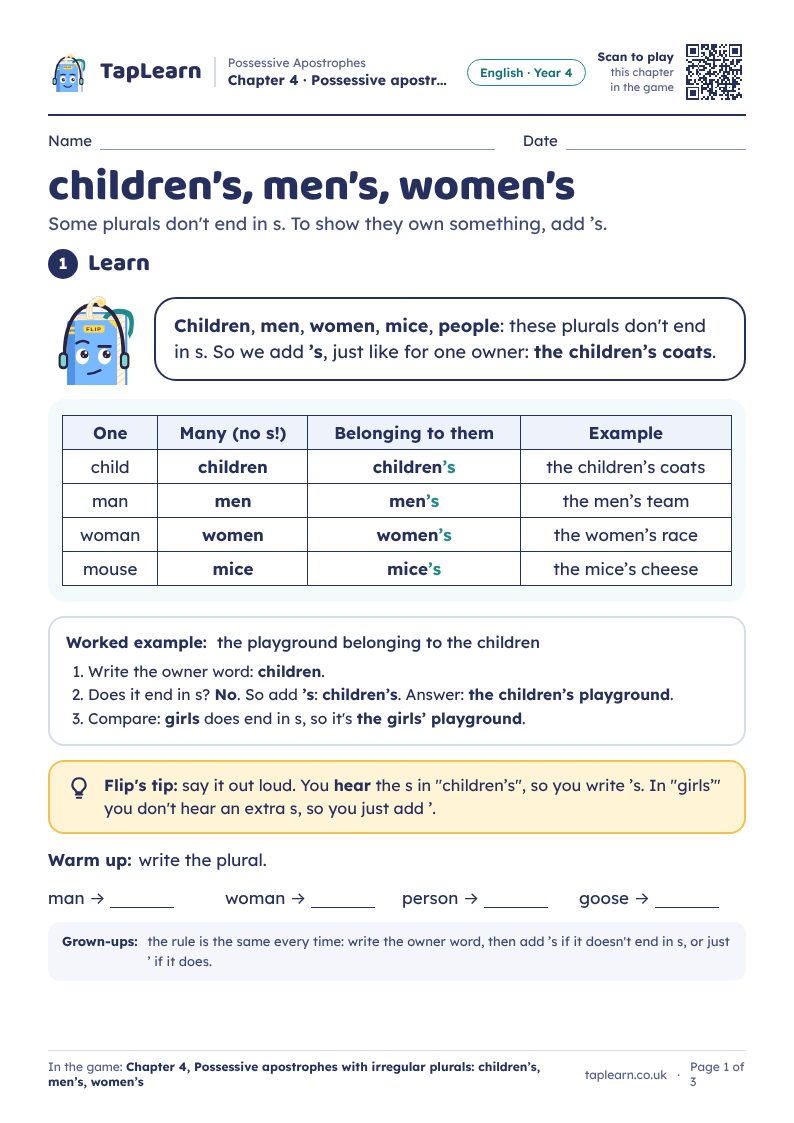
Children’s, Men’s, Women’s is a printable apostrophes with irregular plurals worksheet for Year 4 (ages 8 to 9) that teaches children that plurals not ending in s, like children and women, take ’s just like one owner. It covers the Years 3 to 4 statement on placing the possessive apostrophe accurately in words with regular plurals and in words with irregular plurals.
This worksheet is for members
Membership opens every chapter of every game and every worksheet, for all your children.
See the plansAlready a member? Log in to print it.
Start with the free one: More than one, or belonging? (chapter 1).
Print it on A4, in colour or black and white. Do it after the chapter, or before it to see what your child already knows.
What's on the worksheet
Your child adds ’s to plurals that don't end in s, like children’s, men’s, women’s and mice’s, and tells them apart from girls’ and boys’. Includes a pretend shop signs activity and an answers sheet.
- Page 1 · Learn
- A table of irregular plurals from child to children’s, a worked example writing the children’s playground, Flip's tip to listen for the s, and a write-the-plural warm-up.
- Page 2 · Try it together
- Pretend shop signs: set up piles of clothes or toys for children, men and women, make a sign for each like Children’s Shoes, and add one sign for girls or boys.
- Page 3 · Practise
- Fill in a one, many and belonging table, ring the right spelling, fix three signs, choose ’s or ’ for mixed owners, and a challenge about childrens’.
- Answers sheet
- Every answer, mix-ups like leaving out the s, and sign-hunt and quick-swap ideas.
3 A4 pages and an answers sheet · about 25 minutes
Using it at home
- The rule is the same every time: write the owner word, then add ’s if it doesn't end in s, or just ’ if it does.
- When you're out, look for real signs that say children’s, men’s or women’s and check the apostrophe comes straight after the plural.
- Say "the girls’ shoes" and ask your child to change it to children and spell it: c-h-i-l-d-r-e-n, apostrophe, s.
Watch out for
- Writing childrens’ or womens’.
- Cover up from the apostrophe onwards: what's left must be a real word (children, women).
- Leaving out the s, like children’.
- Say it aloud: we hear "children’s", so the s is written.
- Adding s to make the plural, like childrens or mens.
- These plurals never take an s on their own.
Questions from the worksheet
- Draw a ring round the right spelling: the (childrens’ / children’s) playground, the (mens / men’s) football team, the (women’s / womens’) race.
- Fix the signs. Write each one correctly: Childrens’ Library, Mens Toilets, Womens’ Football.
- Mixed up! Write ’s or ’ in each gap: the boys__ bikes, the men__ boots, the mice__ tails, the teachers__ room.
- Mia says: "childrens’ is right, because children is a plural, and plurals get the apostrophe after the s." Is she right? Explain.
The answers are on the answers sheet, for grown-ups.
National curriculum in England
This worksheet practises these statements from the Years 3–4 english programme of study:
- Indicate grammatical and other features by: indicating possession by using the possessive apostrophe with plural nouns
- Place the possessive apostrophe accurately in words with regular plurals and in words with irregular plurals
In the classroom
- Set up a class shop with signs for children, men, women, girls and boys, and check each apostrophe together.
- Use Practise D as a quick-fire whiteboard check: ’s or ’?
Questions and answers
Where does the apostrophe go in children’s?
Straight after children, then add s: children’s. Children is a plural that doesn't end in s, so it takes ’s.
Is it mens or men’s?
It is men’s. Men is already plural, so add ’s to show belonging: the men’s team.
Why is it the girls’ but the children’s?
Girls ends in s, so just add ’. Children doesn't end in s, so add ’s. You can hear the extra s in children’s.
 TapLearn