Hundreds, tens and ones worksheet for Year 3: Swap ten ones
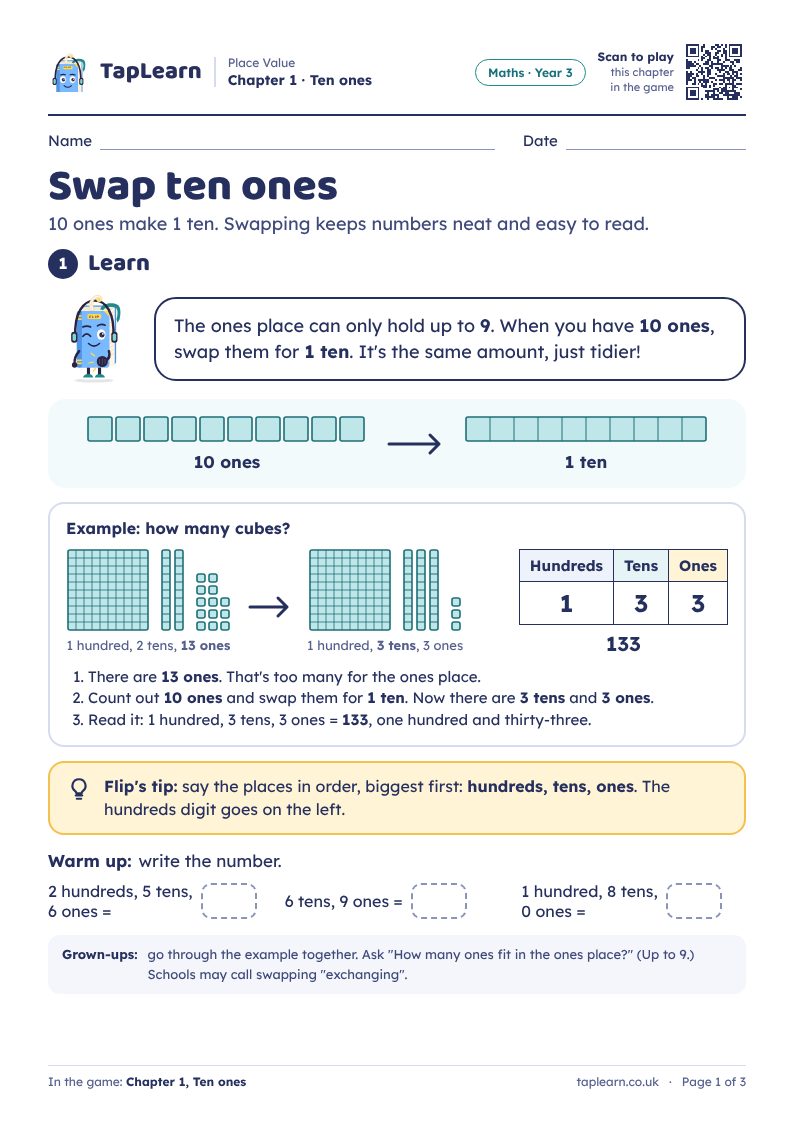
Swap Ten Ones is a printable hundreds, tens and ones worksheet for Year 3 (ages 7 to 8) that teaches children to swap 10 ones for 1 ten and say how many hundreds, tens and ones are in a 3-digit number. It covers the Year 3 maths statement to recognise the place value of each digit in a 3-digit number (100s, 10s, 1s), and to count in multiples of 4 and 8.
Free to print, no account needed.
Print it on A4, in colour or black and white. Do it after the chapter, or before it to see what your child already knows.
What's on the worksheet
Your child swaps 10 ones for 1 ten, says how many hundreds, tens and ones are in a 3-digit number, and counts in 4s and 8s. Includes a grab-and-swap activity with pasta and cups, and an answers sheet.
- Page 1 · Learn
- Cubes show 1 hundred, 2 tens and 13 ones becoming 133 after a swap, with a hundreds, tens and ones chart and a write-the-number warm-up.
- Page 2 · Try it together
- Grab and swap: grab handfuls of pasta onto a paper place value mat, move every 10 ones into a cup on Tens, and record the number after each grab. Then ring 10 ones to swap in pictures.
- Page 3 · Practise
- Swap 10 ones for a ten in a table, count in 4s and 8s, write the hundreds, tens and ones in 352, 253 and 670, and a challenge about 3 hundreds, 2 tens and 14 ones.
- Answers sheet
- Every answer, mix-ups like digits in the wrong order, a tip linking counting in 4s and 8s, and swap shop and say-it-two-ways games.
3 A4 pages and an answers sheet · about 25 minutes
Using it at home
- Ask "How many ones fit in the ones place?" before the example. The answer, up to 9, is the reason for every swap.
- During grab and swap, ask "Why do we swap?" If you fill 10 cups, tip them into a bowl and move it to Hundreds.
- Schools may call swapping "exchanging". Use whichever word your child knows.
Watch out for
- Writing the digits in the wrong order, such as 253 for 352.
- Say it with the places: "3 hundreds, 5 tens, 2 ones". Hundreds always go on the left.
- Leaving 10 or more in one place, like 14 ones.
- Ask "Can the ones place hold 14?" Swap 10 of them for a ten first.
- Missing out the 0 in numbers like 670.
- The 0 shows there are no ones, but it still has to be written.
Questions from the worksheet
- Swap 10 ones for 1 ten: 3 hundreds, 2 tens and 15 ones. Write what you have after the swap, then the number.
- Count in 8s: 0, 8, 16, ___, 32, ___, 48
- How many hundreds, tens and ones are in 352? And in 253?
- Leo has 3 hundreds, 2 tens and 14 ones. He writes the number as 3214. Is he right? What should he write?
The answers are on the answers sheet, for grown-ups.
National curriculum in England
This worksheet practises these statements from the Year 3 maths programme of study:
- Count from 0 in multiples of 4, 8, 50 and 100; find 10 or 100 more or less than a given number
- Recognise the place value of each digit in a 3-digit number (100s, 10s, 1s)
- Compare and order numbers up to 1,000
- Identify, represent and estimate numbers using different representations
- Read and write numbers up to 1,000 in numerals and in words
- Solve number problems and practical problems involving these ideas
Source: National curriculum in England: mathematics programmes of study (DfE)
In the classroom
- Run grab and swap in small groups with place value mats and counters, then compare which group made the most swaps.
- Use the swap shop with coins as a starter: what is three 10p coins and twelve 1p coins?
Questions and answers
What are hundreds, tens and ones?
They are the three places in a 3-digit number. In 352 there are 3 hundreds, 5 tens and 2 ones.
Why do we swap 10 ones for a ten?
Each place can only hold up to 9. When there are 10 ones, swapping them for 1 ten keeps the number the same but lets it be written properly.
How is counting in 8s linked to counting in 4s?
Counting in 8s is every other number when you count in 4s: 4, 8, 12, 16, 20, 24.
 TapLearn