Place value worksheet for Year 3: Building numbers
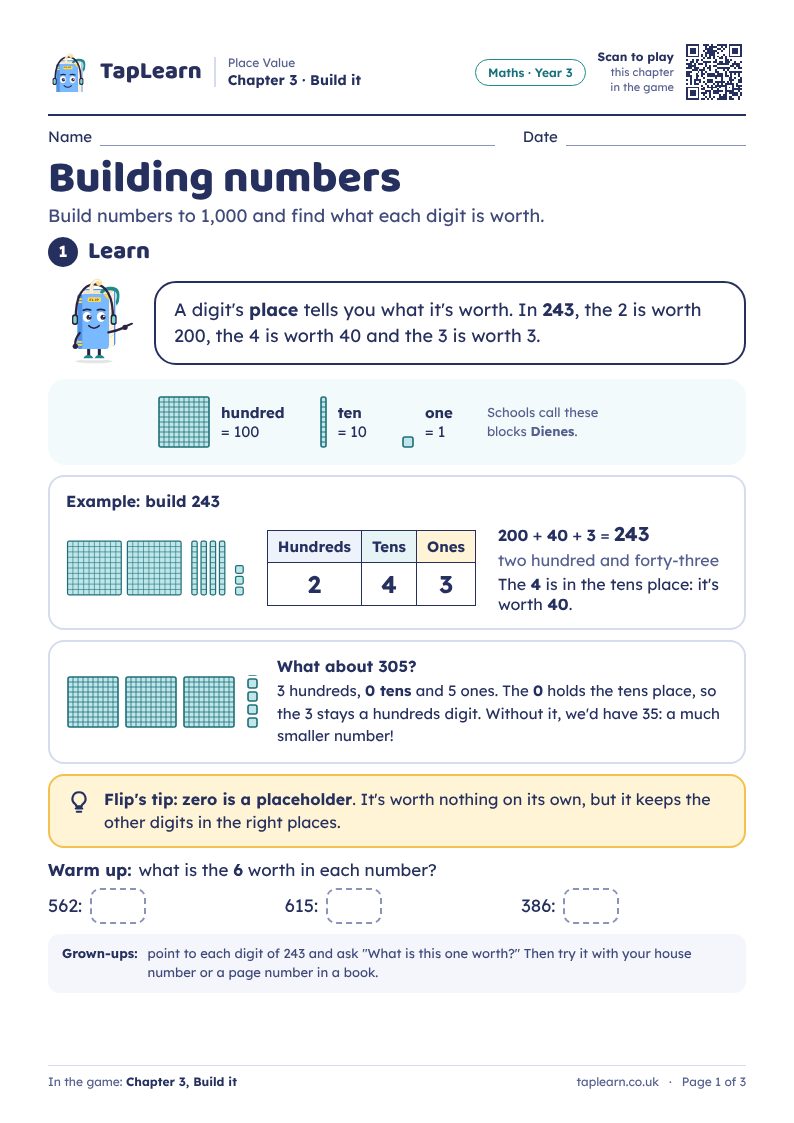
Building Numbers is a printable place value worksheet for Year 3 (ages 7 to 8) that teaches children to build 3-digit numbers from hundreds, tens and ones and say what each digit is worth. It covers the Year 3 maths statement to recognise the place value of each digit in a 3-digit number (100s, 10s, 1s), and to read, write, compare and order numbers up to 1,000.
Free to print, no account needed.
▶ Play chapter 3 in the game · How the dienes (base ten blocks) works
Print it on A4, in colour or black and white. Do it after the chapter, or before it to see what your child already knows.
What's on the worksheet
Your child builds 3-digit numbers with Dienes blocks, finds what each digit is worth, partitions numbers, uses zero as a placeholder, and reads, writes, compares and orders numbers to 1,000. Includes a digit card shuffle and an answers sheet.
- Page 1 · Learn
- Dienes blocks build 243 as 200 + 40 + 3, with an explanation of why the 0 in 305 matters and a warm-up finding what the 6 is worth.
- Page 2 · Try it together
- Digit card shuffle: write three digits on cards, rearrange them to make all six possible numbers, partition each one and put them in order. Then read numbers from blocks.
- Page 3 · Practise
- Say what underlined digits are worth, partition numbers like 572, write numbers in words and digits, compare and order numbers, and a challenge about 305 and 35.
- Answers sheet
- Every answer, mix-ups like writing 65 for six hundred and five, other correct ways to partition, and number spotting and guess-my-number games.
3 A4 pages and an answers sheet · about 30 minutes
Using it at home
- Point to each digit of 243 and ask "What is this one worth?" Then try it with your house number or a page number.
- In the digit card shuffle, point to a card and ask what it's worth in each new number: it's worth more when it moves left.
- To order the six numbers, remind your child to compare the hundreds first, then the tens.
Watch out for
- Saying the 4 in 248 is worth 4 or 400.
- Ask "Which place is it in?" It is in the tens place, so it's worth 40.
- Leaving out the zero, such as writing 65 for six hundred and five.
- Say it in places: 6 hundreds, 0 tens, 5 ones.
- Marking 243 = 200 + 30 + 13 as wrong.
- It's right too: one ten was swapped for 10 ones.
Questions from the worksheet
- What is the underlined digit worth? 248, 715, 389, 507, 460
- Partition: 572 = ___ + ___ + ___
- Write in numbers: six hundred and five
- Compare: write <, > or =. 452 ___ 425
- Ava says, "305 and 35 are the same number, because zero is worth nothing." Is she right? Explain.
The answers are on the answers sheet, for grown-ups.
National curriculum in England
This worksheet practises these statements from the Year 3 maths programme of study:
- Count from 0 in multiples of 4, 8, 50 and 100; find 10 or 100 more or less than a given number
- Recognise the place value of each digit in a 3-digit number (100s, 10s, 1s)
- Compare and order numbers up to 1,000
- Identify, represent and estimate numbers using different representations
- Read and write numbers up to 1,000 in numerals and in words
- Solve number problems and practical problems involving these ideas
Source: National curriculum in England: mathematics programmes of study (DfE)
In the classroom
- Play the digit card shuffle in pairs and ask each pair to explain how they ordered their six numbers.
- Use guess my number as a plenary: "It has 4 hundreds, no tens and 7 ones."
Questions and answers
What is place value in Year 3?
In Year 3, place value means knowing what each digit in a 3-digit number is worth. In 243, the 2 is worth 200, the 4 is worth 40 and the 3 is worth 3.
What are Dienes blocks?
Dienes blocks are maths blocks where a small cube is 1, a stick is 10 and a flat square is 100. They let children build and see numbers.
Why is zero called a placeholder?
Zero is worth nothing on its own, but it keeps the other digits in the right places. In 305 it holds the tens place, so the 3 is worth 300.
 TapLearn