Reading words with digraphs worksheet for Reception: Letter team detectives
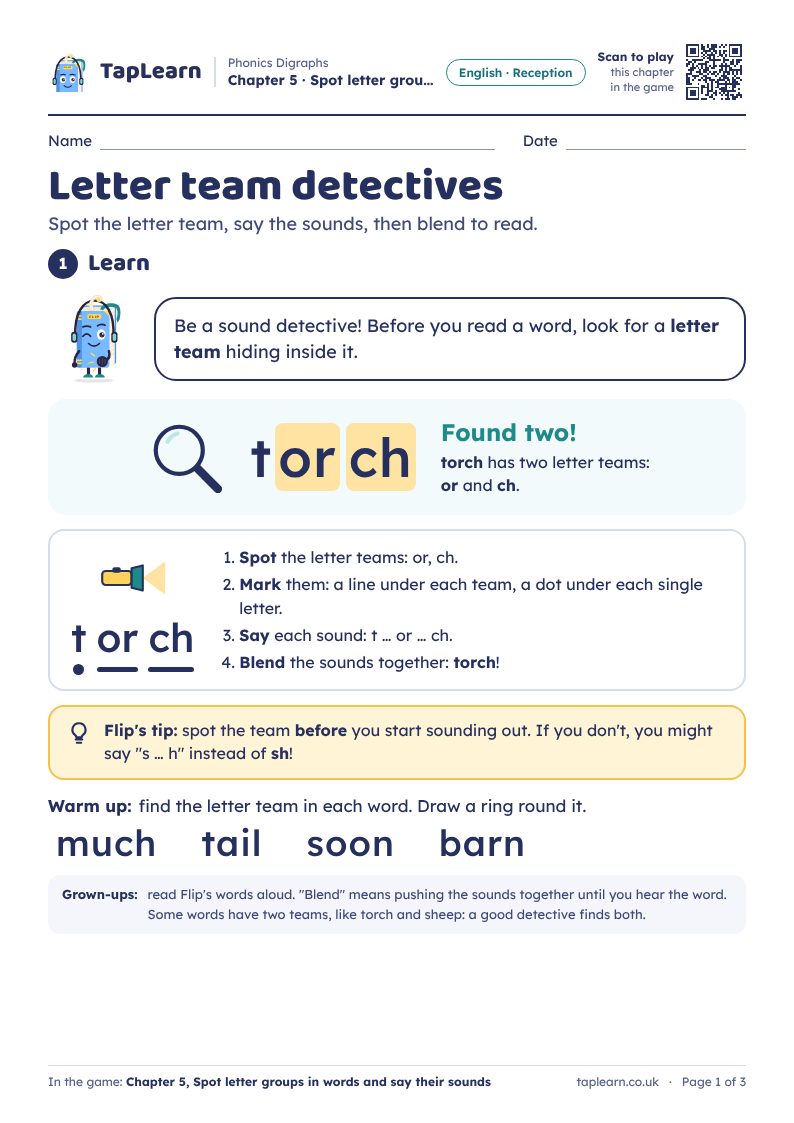
Letter Team Detectives is a printable reading words with digraphs worksheet for Reception (ages 4 to 5) that teaches children to spot letter teams before sounding out, then blend the sounds to read words like torch and sheep. It covers the Reception (EYFS) English goal to read some letter groups that each represent one sound and say sounds for them.
This worksheet is for members
Membership opens every chapter of every game and every worksheet, for all your children.
See the plansAlready a member? Log in to print it.
Start with the free one: Letter sounds a to z (chapter 1).
Print it on A4, in colour or black and white. Do it after the chapter, or before it to see what your child already knows.
What's on the worksheet
Your child spots the letter teams in words, draws sound buttons, counts the sounds and blends to read words like ship, rain and moon. Includes a word-strip activity and an answers sheet.
- Page 1 · Learn
- Torch with two letter teams, or and ch, four detective steps from spotting to blending, Flip's tip to spot the team first, and a ring-the-letter-team warm-up.
- Page 2 · Try it together
- Word strips: the grown-up writes ship, rain, moon and night on paper strips, the child underlines the letter team, says the sounds and blends to read each word.
- Page 3 · Practise
- Match words like teeth and shark to pictures, ring the right word such as chip or ship, draw sound buttons and count the sounds in zoo, light, car and shed, and a challenge.
- Answers sheet
- Every answer, mix-ups like counting letters instead of sounds, and underline-game and robot-talk ideas.
3 A4 pages and an answers sheet · about 20 minutes
In the classroom
- Use word strips with a group, each child underlining the team before the group blends the word.
- Play robot talk as a quick oral blending warm-up before reading.
Questions from the worksheet
- Look at the picture. Which word is it? Draw a ring round the right word: chip or ship, boat or boot, feet or fight, rain or ring.
- Draw the sound buttons under each word. How many sounds does it have? zoo, light, car, shed.
- Leo says, "sheep has one letter team." Is he right? Draw the sound buttons to check.
The answers are on the answers sheet, for grown-ups.
National curriculum in England
This worksheet practises this statement from the Reception english programme of study:
- Read some letter groups that each represent one sound and say sounds for them
Using it at home
- If blending is tricky, say the sounds again, a bit faster each time: "sh … i … p, sh-i-p, ship!"
- Add more word strips of your own, like chop, seed, coat and fork.
- Play robot talk: say a word in sounds, "sh … ee … p", and your child blends it. Then swap.
Watch out for
- Splitting a team, like s … h for sh.
- Ask "Can you see a letter team?" before your child starts sounding out.
- Reading the wrong sound for a team, like chip as ship.
- Point to the team on its own and ask for its sound, then blend again. Check the picture matches.
- Counting letters, not sounds.
- light has 5 letters but 3 sounds. Count the buttons, not the letters.
Questions and answers
What does blending mean in phonics?
Blending means pushing sounds together until you hear the word, like sh … i … p making ship.
Can a word have two letter teams?
Yes. Torch has or and ch, and sheep has sh and ee. A good sound detective finds both.
Why count sounds instead of letters?
A letter team makes one sound, so words often have fewer sounds than letters. light has 5 letters but 3 sounds.
 TapLearn