Letter sounds worksheet for Reception: Letter sounds a to z
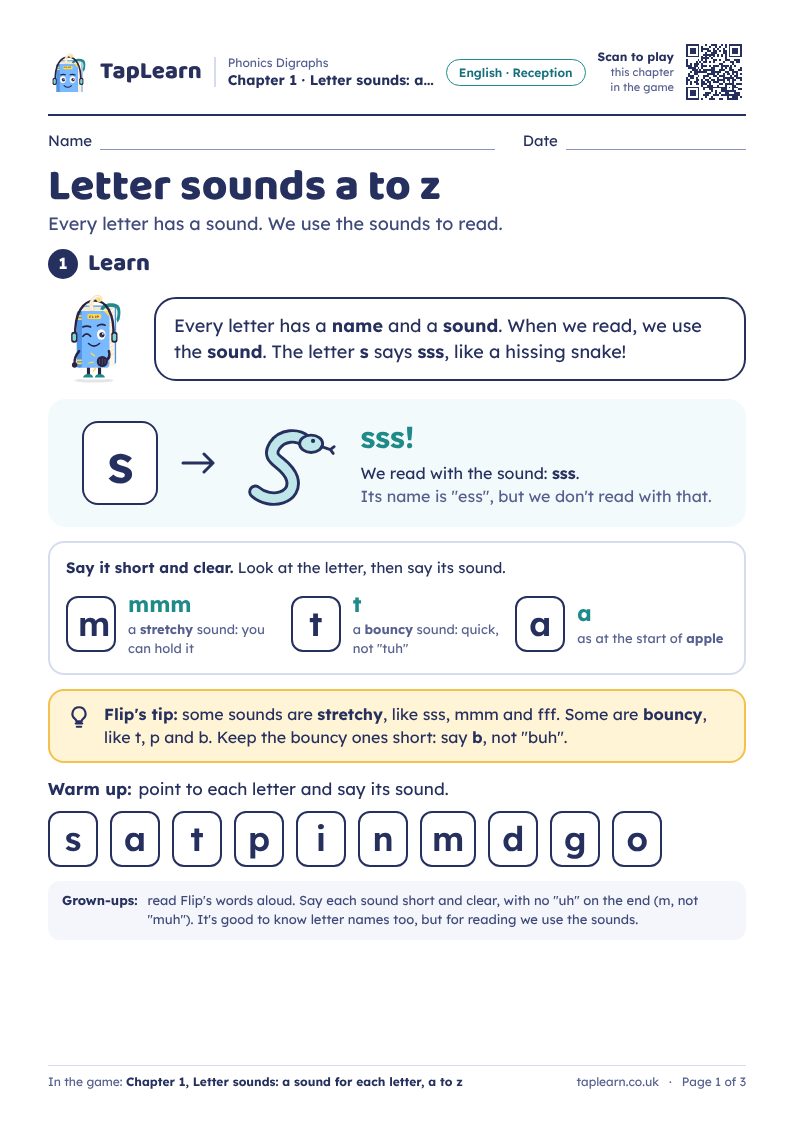
Letter Sounds a to z is a printable letter sounds worksheet for Reception (ages 4 to 5) that teaches children to use each letter's sound, not its name, and to keep bouncy sounds short. It covers the Reception (EYFS) English goal to say a sound for each letter in the alphabet.
Free to print, no account needed.
Print it on A4, in colour or black and white. Do it after the chapter, or before it to see what your child already knows.
What's on the worksheet
Your child says a sound for each letter from a to z, hears the first sound in a word and learns to tell b from d. Includes a sound hunt round the home and an answers sheet.
- Page 1 · Learn
- How a letter's name and sound differ, stretchy sounds like mmm and bouncy sounds like t, Flip's tip on saying b, not buh, and a say-the-sound warm-up for s, a, t, p, i, n, m, d, g and o.
- Page 2 · Try it together
- Sound hunt: point to a letter, say its sound together, then hunt round the room for things that start with it, like sock or mug, and draw or write two finds.
- Page 3 · Practise
- Ring the first sound for pictures like sun and web, write b or d in words like dog and bed with the bed hand trick, colour each letter a to z you know, and a challenge.
- Answers sheet
- Every answer, mix-ups like using letter names or adding "uh", and I-spy-with-sounds and sound-of-the-day ideas.
3 A4 pages and an answers sheet · about 20 minutes
In the classroom
- Pick a sound of the day and ask children to spot it around the classroom.
- Use Practise C as a quick one-to-one check, colouring each letter a child can sound.
Questions from the worksheet
- Say the word for the picture. What is its first sound? Draw a ring round the letter.
- b or d? Say the word for the picture. Write b or d in each gap: _og, _all, _uck, _e_.
- Sam says, "The first sound in sun is ess." Is he right? What is the first sound? Talk about it, then write it.
The answers are on the answers sheet, for grown-ups.
National curriculum in England
This worksheet practises this statement from the Reception english programme of study:
- Say a sound for each letter in the alphabet and at least 10 digraphs
Using it at home
- Say each sound short and clear, with no "uh" on the end: m, not muh. Letter names are good to know, but for reading we use the sounds.
- In the sound hunt, a cup or a kettle is a great find for both c and k, because they make the same sound.
- Play I spy with sounds: "I spy something beginning with sss."
Watch out for
- Using letter names instead of sounds, like "ess" for s.
- Say: "That's its name. What sound does it make?"
- Mixing up b and d.
- Use the bed trick: two fists, thumbs up, knuckles together. Or think of bed: it starts with b and ends with d.
- Adding "uh" to sounds, like muh or tuh.
- Model short, pure sounds: hold stretchy ones (mmm) and clip bouncy ones (t). It makes blending easier later.
Questions and answers
What is the difference between a letter's name and its sound?
The name is what we call the letter, like "ess", and the sound is what it says when we read, like sss. Children read with the sounds.
How can my child stop mixing up b and d?
Try the bed trick: make two fists with thumbs up and knuckles together. The left hand makes b and the right hand makes d, like the word bed.
What sounds do x and q make?
x says ks, as in box. q nearly always comes with u to say kw, as in queen.
 TapLearn