Most and least worksheet for Year 1
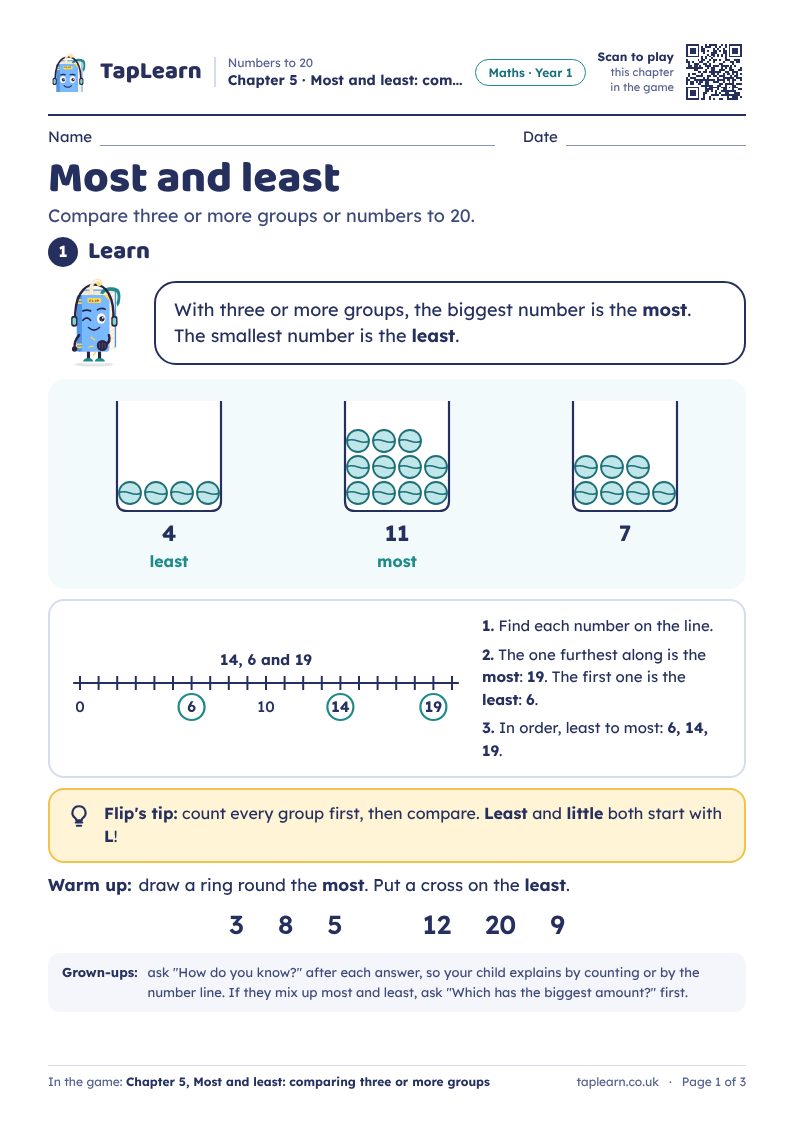
Most and Least is a printable most and least worksheet for Year 1 (ages 5 to 6) that teaches children to compare three or more groups or numbers to 20 and put them in order from least to most. It covers the Year 1 maths statement to identify and represent numbers using objects and pictures, including the number line, and use the language of most and least.
This worksheet is for members
Membership opens every chapter of every game and every worksheet, for all your children.
See the plansAlready a member? Log in to print it.
Start with the free one: Numbers 1 to 10 (chapter 1).
Print it on A4, in colour or black and white. Do it after the chapter, or before it to see what your child already knows.
What's on the worksheet
Your child finds the most and the least in three or more groups or numbers to 20, and puts numbers in order from least to most. Includes a colour-sorting activity and an answers sheet.
- Page 1 · Learn
- What most and least mean, a worked example ordering 14, 6 and 19 on a number line, Flip's tip that least and little both start with L, and a ring-the-most warm-up.
- Page 2 · Try it together
- Colour count: sort toy bricks, pens or pegs into 3 colour groups, count each group, find the most and the least, then line the groups up from least to most.
- Page 3 · Practise
- Ring the box with the most and cross the least, ring and underline numbers, write numbers in order, draw cherries to make a plate the most or the least, and a challenge.
- Answers sheet
- Every answer, mix-ups like looking only at the last digit, and three-piles and teddy-snack ideas.
3 A4 pages and an answers sheet · about 20 minutes
In the classroom
- Run colour count in groups with mixed cubes, then compare results across the class.
- Use Leo's challenge on mini-whiteboards: children write 9, 14 and 11 in order from least to most.
Questions from the worksheet
- Draw a ring round the box with the most. Put a cross on the box with the least.
- Write in order, from least to most.
- Leo says, "In 9, 14 and 11, the most is 9, because 9 is the biggest digit." Is he right? Which is the most?
The answers are on the answers sheet, for grown-ups.
National curriculum in England
This worksheet practises this statement from the Year 1 maths programme of study:
- Identify and represent numbers using objects and pictorial representations including the number line, and use the language of: equal to, more than, less than (fewer), most, least
Source: National curriculum in England: mathematics programmes of study (DfE)
Using it at home
- Ask "How do you know?" after each answer, so your child explains by counting or using the number line.
- In colour count, keep each group under 20 and ask "How could we make the least group into the most?"
- Give three teddies some pegs each and ask who has the most and who has the least.
Watch out for
- Mixing up most and least.
- Most is the biggest amount and least is the smallest. Ask "Which has the biggest amount?" first.
- Looking only at the last digit, thinking 9 is more than 14.
- Show both in ten frames: 14 has a full ten.
- Not counting every group.
- A group can look small but have more in it: count first.
Questions and answers
What do most and least mean in maths?
Most is the biggest amount in a set of groups or numbers, and least is the smallest. In 14, 6 and 19, the most is 19 and the least is 6.
How do you order numbers to 20 from least to most?
Find each number on a number line. The one nearest 0 is the least and the one furthest along is the most.
Why is 14 more than 9?
14 is one ten and 4 more, but 9 has no ten at all. Showing both in ten frames makes this clear.
 TapLearn