Greater than and less than worksheet for Year 1: More or fewer?
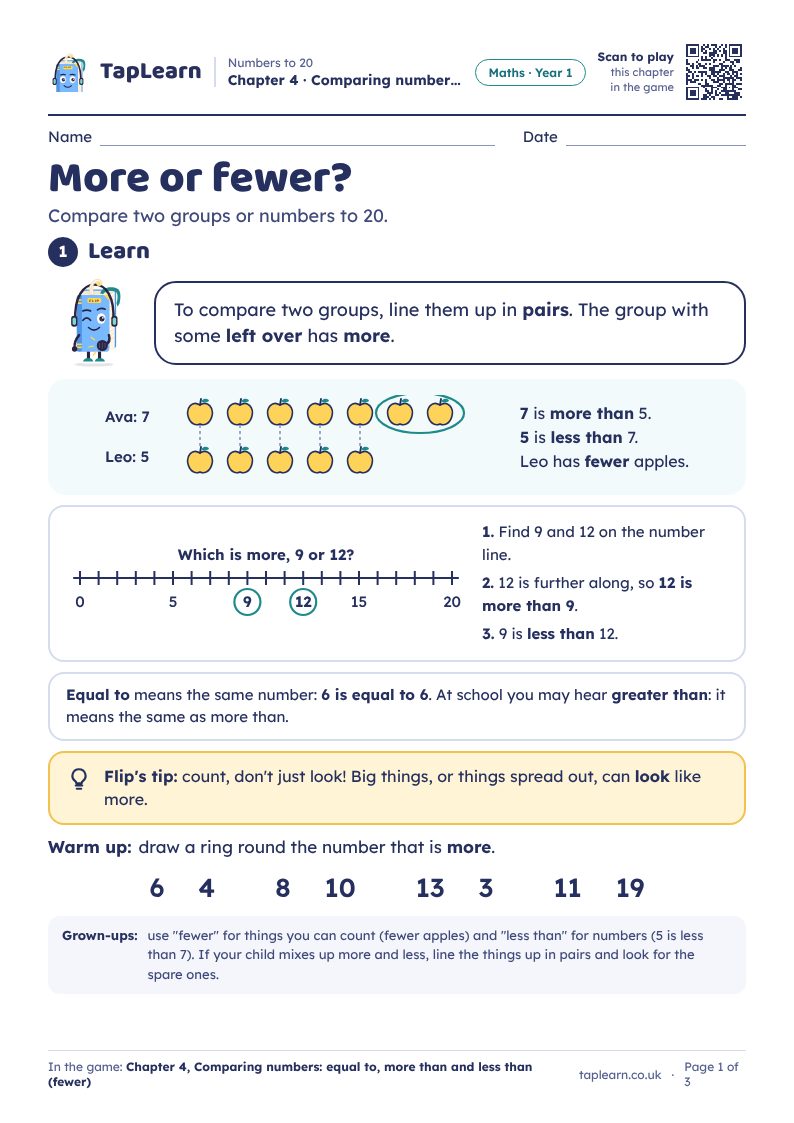
More or Fewer? is a printable greater than and less than worksheet for Year 1 (ages 5 to 6) that teaches children to compare two groups or numbers to 20 by lining things up in pairs and using a number line. It covers the Year 1 maths statement to identify and represent numbers using objects and pictures, including the number line, and use the language of equal to, more than and less than (fewer).
This worksheet is for members
Membership opens every chapter of every game and every worksheet, for all your children.
See the plansAlready a member? Log in to print it.
Start with the free one: Numbers 1 to 10 (chapter 1).
▶ Play chapter 4 in the game · How the greater than and less than works
Print it on A4, in colour or black and white. Do it after the chapter, or before it to see what your child already knows.
What's on the worksheet
Your child compares two groups or numbers to 20 using equal to, more than, less than and fewer, by pairing things up and using a number line. Includes a grab-and-compare activity and an answers sheet.
- Page 1 · Learn
- Two rows of apples lined up in pairs to show 7 is more than 5, a worked example comparing 9 and 12 on a number line, what equal to and greater than mean, and a warm-up.
- Page 2 · Try it together
- Grab and compare: each take a handful of pasta, guess who has more, line them up in pairs, count and say "9 is more than 7", then move some across to make them equal.
- Page 3 · Practise
- Ring rows with more and fewer, ring more than, less than or equal to, draw fewer cakes and equal cherries, write numbers that make it true, and a challenge about 9 and 12.
- Answers sheet
- Every answer, mix-ups like thinking bigger things are more, and plate-check and one-more-one-less ideas.
3 A4 pages and an answers sheet · about 20 minutes
In the classroom
- Play grab and compare in pairs with cubes, recording each round in the table.
- Use Ava's challenge as a talk partner starter, proving the answer with ten frames or a number line.
Questions from the worksheet
- Count each row. Draw a ring round the row with fewer.
- Draw a ring round the right words: 8 more than, less than or equal to 12.
- Write a number that makes it true: ___ is more than 15. ___ is less than 4. 9 is equal to ___.
- Ava says, "9 is more than 12, because 9 is bigger than 2." Is she right? How do you know?
The answers are on the answers sheet, for grown-ups.
National curriculum in England
This worksheet practises this statement from the Year 1 maths programme of study:
- Identify and represent numbers using objects and pictorial representations including the number line, and use the language of: equal to, more than, less than (fewer), most, least
Source: National curriculum in England: mathematics programmes of study (DfE)
Using it at home
- Use "fewer" for things you can count (fewer apples) and "less than" for numbers (5 is less than 7).
- In grab and compare, ask "Who has fewer? How many fewer?" and point to the spare ones.
- At snack time, ask which plate has more and which has fewer, then make them equal.
Watch out for
- Thinking big or spread-out things are more.
- Count, or line the things up in pairs.
- Swapping more and less.
- The group with spare ones left over has more; the other has fewer.
- Looking only at the last digit, thinking 9 is more than 12.
- Remember the ten in 12: show it in ten frames.
Questions and answers
What is the difference between fewer and less than?
Use fewer for things you can count, like fewer apples, and less than for numbers, like 5 is less than 7.
Is greater than the same as more than?
Yes. At school children may hear greater than, which means the same as more than.
How do you compare two groups in Year 1?
Line them up in pairs. The group with some left over has more, and the other has fewer. If none are left over, they are equal.
 TapLearn