Mixed numbers to improper fractions worksheet for Year 5: Mixed to top-heavy
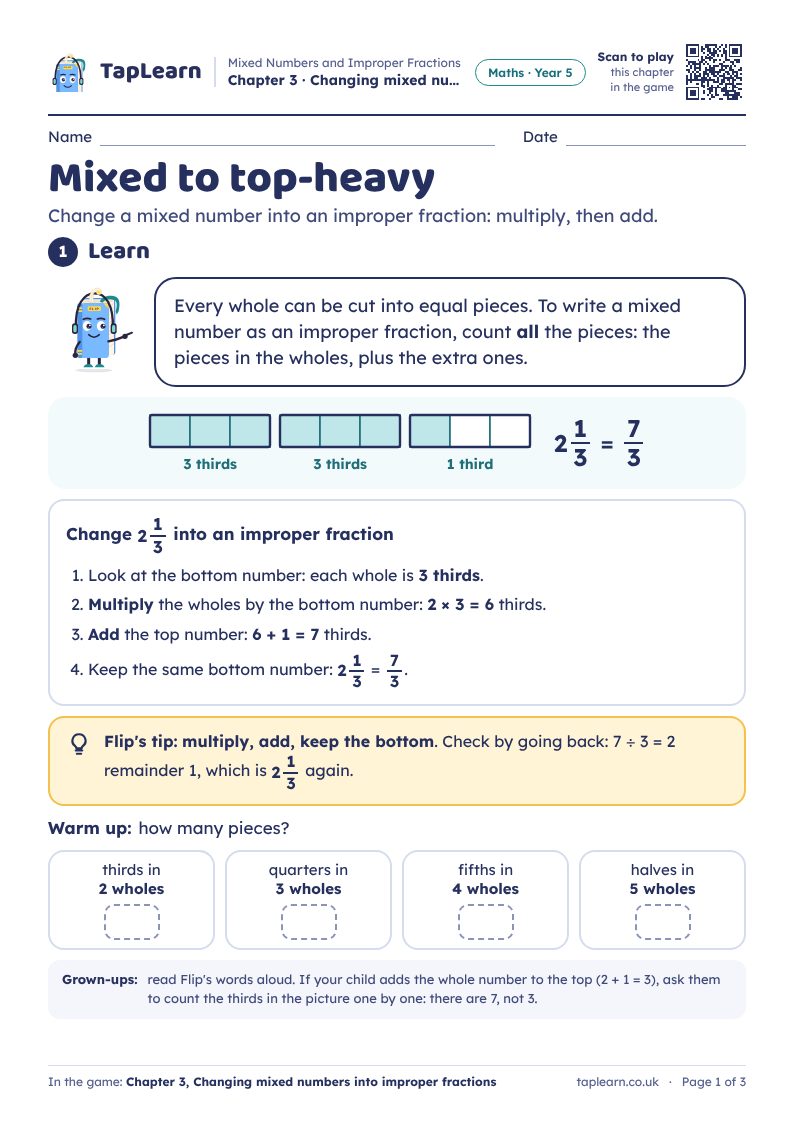
Mixed to Top-Heavy is a printable mixed numbers to improper fractions worksheet for Year 5 (ages 9 to 10) that teaches children to multiply the wholes by the bottom number and add the top number, so 2 1/3 = 7/3. It covers the Year 5 maths statement on converting mixed numbers to improper fractions.
This worksheet is for members
Membership opens every chapter of every game and every worksheet, for all your children.
See the plansAlready a member? Log in to print it.
Start with the free one: Proper, improper, mixed (chapter 1).
Print it on A4, in colour or black and white. Do it after the chapter, or before it to see what your child already knows.
What's on the worksheet
Your child changes mixed numbers into improper fractions by multiplying the wholes and adding the extra parts, like 2 1/3 = 7/3. Includes a clock activity counting quarter and half hours, and an answers sheet.
- Page 1 · Learn
- Bars showing 2 1/3 as 7 thirds, a worked example of multiply, add and keep the bottom, Flip's tip to check by going back, and a how-many-pieces warm-up.
- Page 2 · Try it together
- Clock pieces: move a clock's minute hand round in quarter hours to count how many are in 2 1/4 hours, then count half hours in 3 1/2 hours, and write each as an improper fraction.
- Page 3 · Practise
- Write shaded shapes as improper fractions, change eight mixed numbers, match four mixed numbers to fractions that all have 13 on top, missing numbers, and a challenge.
- Answers sheet
- Every answer, mix-ups like adding the whole number to the top, and half-hour and pizza-slice ideas.
3 A4 pages and an answers sheet · about 25 minutes
In the classroom
- Use the warm-up as a quick-fire oral starter: how many quarters in 3 wholes?
- Use Practise C in pairs and ask why all four mixed numbers have 13 on top.
Questions from the worksheet
- Change each mixed number into an improper fraction: 1 2/5, 3 1/2, 2 3/4, 4 1/3, 2 5/6, 5 1/4.
- Draw a line to match. Careful: all the top numbers are 13! 3 1/4, 1 5/8, 2 3/5, 6 1/2.
- Leo says 2 1/3 = 3/3 "because 2 + 1 = 3". Is he right? How could a picture help him see?
The answers are on the answers sheet, for grown-ups.
National curriculum in England
This worksheet practises this statement from the Year 5 maths programme of study:
- Recognise mixed numbers and improper fractions and convert from one form to the other and write mathematical statements > 1 as a mixed number
Source: National curriculum in England: mathematics programmes of study (DfE)
Using it at home
- If your child adds the whole number to the top, ask them to count the thirds in the picture one by one: there are 7, not 3.
- After the clock activity, show the quick way: "2 hours is 2 x 4 = 8 quarters, and 1 more quarter makes 9."
- Ask your child to check an answer by changing it back: 7 divided by 3 is 2 remainder 1, which is 2 1/3 again.
Watch out for
- Adding the whole number to the top, like 2 1/3 as 3/3.
- The whole number counts wholes, not pieces: multiply it by the bottom number first.
- Forgetting to add the top number, like 6/3.
- That's only the 2 wholes: the extra third is missing.
- Multiplying by the top number instead of the bottom, like 5/3.
- Multiply the wholes by the bottom number: that's how many pieces are in each whole.
Questions and answers
How do you change a mixed number into an improper fraction?
Multiply the whole number by the bottom number, add the top number, and keep the same bottom number. 2 1/3 is 2 x 3 = 6, plus 1, so 7/3.
Why do you multiply by the denominator?
The denominator tells you how many pieces make one whole, so multiplying finds how many pieces are in all the wholes.
How can you check the answer?
Change it back by dividing: 7/3 is 7 divided by 3, which is 2 remainder 1, so 2 1/3.
More worksheets from Mixed Numbers and Improper Fractions: A Rocket Fuel Mission
- Chapter 1: Proper and improper fractions worksheet: Proper, improper, mixed Free
- Chapter 2: Improper fractions to mixed numbers worksheet: Top-heavy to mixed Members
- Chapter 4: Fractions on a number line worksheet: Fractions on a line Members
- Chapter 5: Adding fractions worksheet: Totals over one Members
 TapLearn