Proper and improper fractions worksheet for Year 5: Proper, improper, mixed
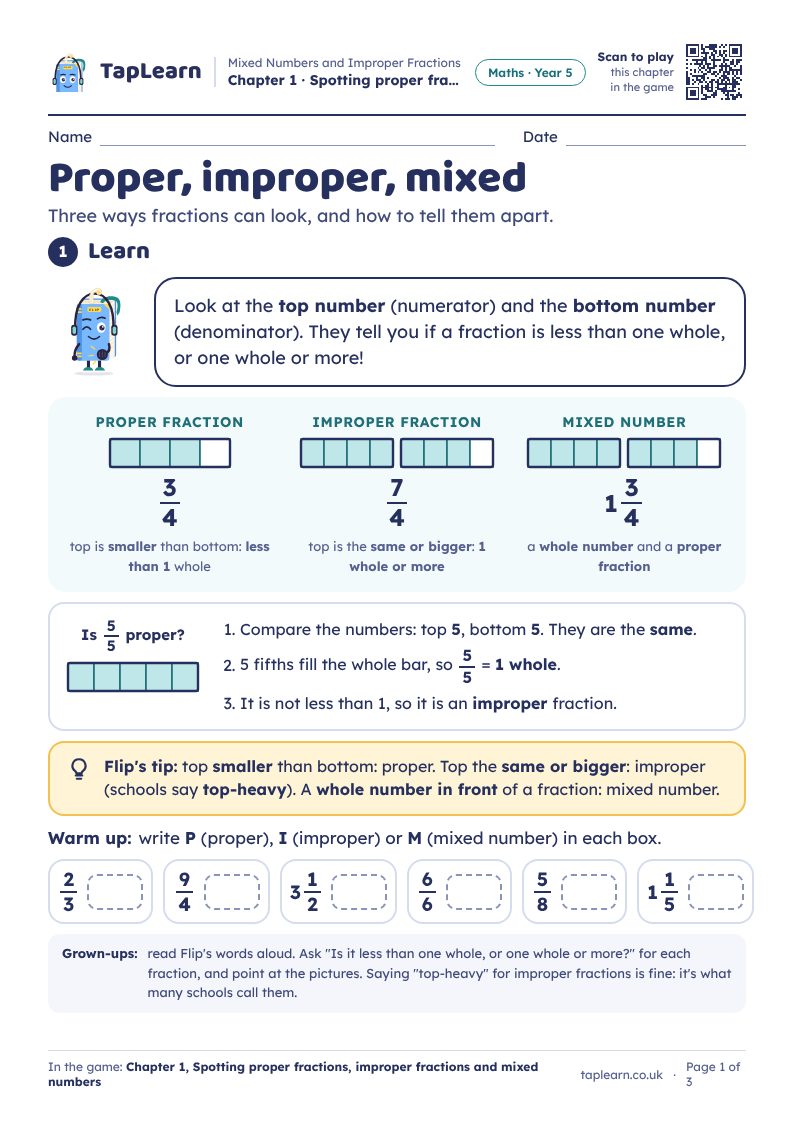
Proper, Improper, Mixed is a printable proper and improper fractions worksheet for Year 5 (ages 9 to 10) that teaches children to compare the top and bottom numbers to tell proper fractions, improper fractions and mixed numbers apart. It covers the Year 5 maths statement on recognising mixed numbers and improper fractions.
Free to print, no account needed.
Print it on A4, in colour or black and white. Do it after the chapter, or before it to see what your child already knows.
What's on the worksheet
Your child tells proper fractions, improper (top-heavy) fractions and mixed numbers apart, and sees why 5/5 is one whole. Includes a paper-quarters activity and an answers sheet.
- Page 1 · Learn
- What proper fractions, improper fractions and mixed numbers look like, a worked example showing why 5/5 is improper, Flip's tip on top-heavy fractions, and a P, I or M warm-up.
- Page 2 · Try it together
- Paper quarters: tear 3 sheets of paper into quarters, lay out 7 quarters, write it as an improper fraction, then fit the pieces into whole sheets to find the mixed number.
- Page 3 · Practise
- Sort nine fractions into proper, improper and mixed, write shaded shapes both ways, less than, equal to or more than 1, true or false, and a challenge about an upside-down fraction.
- Answers sheet
- Every answer, mix-ups like calling 5/5 proper, and quick-sort and food-fraction ideas.
3 A4 pages and an answers sheet · about 25 minutes
Using it at home
- For each fraction, ask "Is it less than one whole, or one whole or more?" Saying "top-heavy" for improper fractions is fine.
- In paper quarters, lay out exactly 4 quarters and ask what they make. It shows why 4/4 is 1 whole and not a proper fraction.
- If your child writes a fraction upside down, say it as "7 pieces, each a third": the piece size goes on the bottom.
Watch out for
- Thinking 7/4 is less than one.
- Ask "How many quarters make a whole?" (4.) 7 is more than 4.
- Calling 5/5 a proper fraction.
- It's exactly one whole, and proper fractions are always less than 1.
- Writing fractions upside down, like 3/7 for 7/3.
- Say "7 pieces, each a third": the size of the pieces goes on the bottom.
Questions from the worksheet
- Sort the fractions into proper, improper and mixed number: 4/7, 11/6, 2 1/3, 8/8, 1/9, 5 2/5, 13/10, 9/10, 3 3/4.
- Tick: less than 1, equal to 1, or more than 1? 3/8, 12/12, 10/7, 1 1/6.
- True or false? 7/4 is less than 1 whole. 4/4 is a proper fraction. 2 1/2 is more than 2.
- Sam looked at a picture with 7 thirds shaded and wrote 3/7. Is Sam right? What should Sam write?
The answers are on the answers sheet, for grown-ups.
National curriculum in England
This worksheet practises this statement from the Year 5 maths programme of study:
- Recognise mixed numbers and improper fractions and convert from one form to the other and write mathematical statements > 1 as a mixed number
Source: National curriculum in England: mathematics programmes of study (DfE)
In the classroom
- Use the warm-up as a mini-whiteboard check: pupils show P, I or M for each fraction you call out.
- Run paper quarters in small groups, each group choosing its own number of quarters to record both ways.
Questions and answers
What is an improper fraction?
An improper fraction has a numerator the same as or bigger than its denominator, like 7/4 or 5/5, so it is one whole or more. Schools often call it top-heavy.
What is the difference between a proper and an improper fraction?
A proper fraction is less than 1 whole, so its top number is smaller than its bottom number. An improper fraction is 1 whole or more.
What is a mixed number?
A mixed number is a whole number and a proper fraction together, like 1 3/4.
More worksheets from Mixed Numbers and Improper Fractions: A Rocket Fuel Mission
- Chapter 2: Improper fractions to mixed numbers worksheet: Top-heavy to mixed Members
- Chapter 3: Mixed numbers to improper fractions worksheet: Mixed to top-heavy Members
- Chapter 4: Fractions on a number line worksheet: Fractions on a line Members
- Chapter 5: Adding fractions worksheet: Totals over one Members
 TapLearn