Roots and root hairs worksheet for Year 3: Root hairs and water
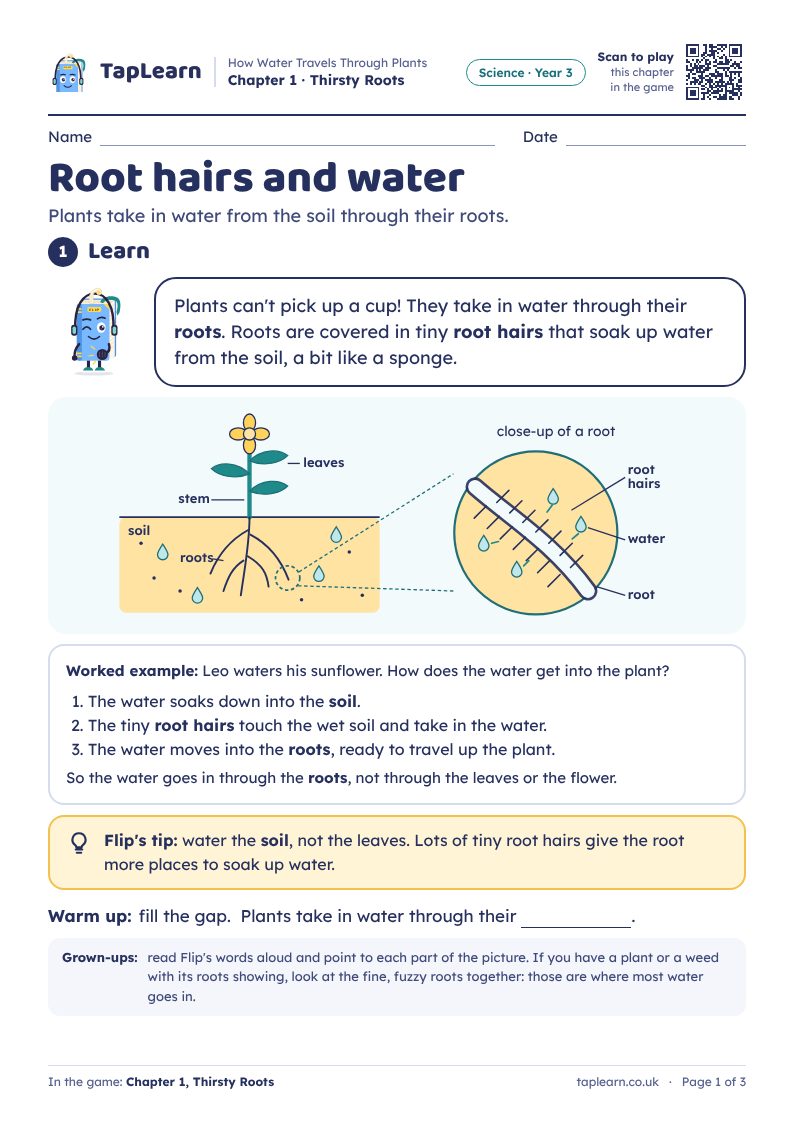
Root Hairs and Water is a printable roots and root hairs worksheet for Year 3 (ages 7 to 8) that teaches children that plants take in water from the soil through their roots and tiny root hairs. It covers the Year 3 science statement to investigate the way in which water is transported within plants.
Free to print, no account needed.
Print it on A4, in colour or black and white. Do it after the chapter, or before it to see what your child already knows.
What's on the worksheet
Your child learns that plants take in water through their roots, using tiny root hairs that soak up water from the soil, and why we water the soil, not the leaves. Includes a sponge root test and an answers sheet.
- Page 1 · Learn
- A plant with a close-up of a root shows root hairs in wet soil, with a worked example of how water from a watering can gets into a sunflower and a fill-the-gap warm-up.
- Page 2 · Try it together
- Sponge root test: stand a dry sponge and a smooth lid in a saucer of water and see which soaks water up, like a root covered in root hairs. Then label the parts of a plant.
- Page 3 · Practise
- True or false questions about roots, fill the gaps about water's way in, explain why a weed with broken root hairs struggles, and a challenge about spraying leaves.
- Answers sheet
- Every answer, the common idea that plants drink through their leaves, and a root hunt and watering check to try at home.
3 A4 pages and an answers sheet · about 25 minutes
In the classroom
- Run the sponge root test in groups with different materials, such as kitchen roll, foil and sponge, and compare how high the water climbs.
- Pull up a weed in the school grounds and pass it round with hand lenses to find the root hairs.
Questions from the worksheet
- True or false? Plants take in water through their flowers.
- True or false? Spraying the leaves is the best way to give a plant water.
- Mia pulls up a weed roughly, and most of its tiny root hairs break off. She plants it again. Why might it struggle to get enough water?
- Sam says, "Plants drink through their leaves, so I'll spray the leaves and never water the soil." Is Sam right? What would you tell him?
The answers are on the answers sheet, for grown-ups.
National curriculum in England
This worksheet practises this statement from the Year 3 science programme of study:
- Investigate the way in which water is transported within plants
Source: National curriculum in England: science programmes of study (DfE)
Using it at home
- If you have a weed or plant with its roots showing, look at the fine, fuzzy roots together: that is where most water goes in.
- In the sponge test, ask "Which one is more like a root with lots of root hairs?" once the water has climbed.
- Let your child water a plant at home and explain where the water needs to go and why.
Watch out for
- Thinking plants drink through their leaves or flowers.
- Ask: "Where does the rain go after it lands?" It drips down into the soil, where the roots take it in.
- Thinking root hairs are big.
- They are tiny, finer than a hair on your head. The fuzzy look of fine roots comes from thousands of them.
- Forgetting that roots have another job.
- Roots also hold the plant firmly in the ground.
Questions and answers
How do plants take in water?
Plants take in water through their roots. Tiny root hairs on the roots soak up water from the soil, a bit like a sponge.
What are root hairs?
Root hairs are tiny hair-like parts that cover a plant's roots. They give the root more places to soak up water from the soil.
Should you water a plant's leaves or its soil?
Water the soil. The roots take in water from the soil, so spraying only the leaves lets the soil dry out and the plant wilts.
 TapLearn