Celery experiment worksheet for Year 3: The coloured water test
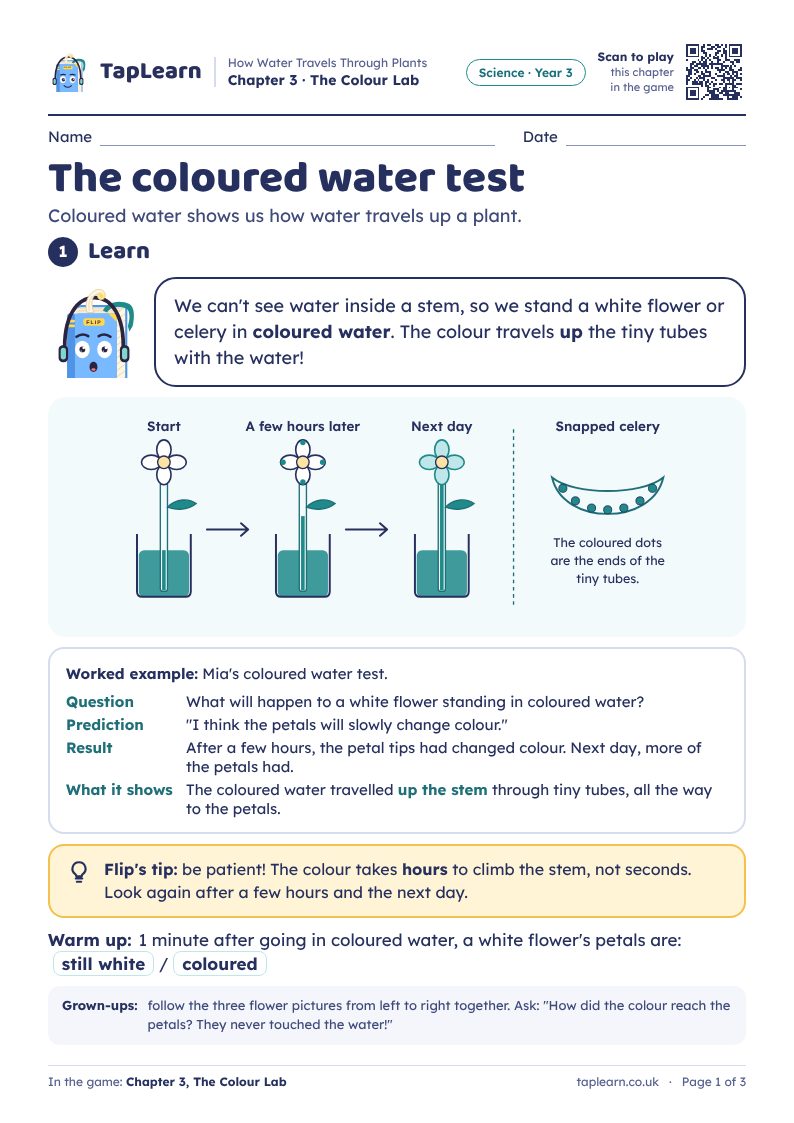
The Coloured Water Test is a printable celery experiment worksheet for Year 3 (ages 7 to 8) that teaches children to predict and explain what happens when celery or a white flower stands in coloured water. It covers the Year 3 science statement to investigate the way in which water is transported within plants.
This worksheet is for members
Membership opens every chapter of every game and every worksheet, for all your children.
See the plansAlready a member? Log in to print it.
Start with the free one: Root hairs and water (chapter 1).
Print it on A4, in colour or black and white. Do it after the chapter, or before it to see what your child already knows.
What's on the worksheet
Your child predicts and explains what happens when celery or a white flower stands in coloured water, and why the colour takes hours to appear. Includes a celery colour test to set up together and an answers sheet.
- Page 1 · Learn
- Pictures of a white flower in coloured water over a day and snapped celery, with Mia's question, prediction, result and conclusion, and a warm-up.
- Page 2 · Try it together
- Celery colour test: stand celery in water with food colouring, predict, look after an hour, a few hours and next morning, then snap it to see the coloured dots. Then order three pictures.
- Page 3 · Practise
- Ring the right endings about how and how fast the colour travels, predict which of three flowers will change colour and explain why, and a challenge about colour soaking in from outside.
- Answers sheet
- Every answer, what to do if nothing shows after an hour, the two common mix-ups, and a what-if question about warm and cold rooms.
3 A4 pages and an answers sheet · about 25 minutes
In the classroom
- Set up celery tests with different colours in groups at the start of the day and check them at lunch and home time.
- Use the three-flower prediction in Practise C as a discussion before revealing the answer.
Questions from the worksheet
- Ring the right ending: The colour gets into the petals by soaking in from outside / going up the stem.
- Ring the right ending: The petals change colour straight away / slowly, over hours.
- Predict! Which flower's petals will change colour by tomorrow? Why did you choose that flower?
- Leo says, "The colour soaked into the petals from the outside, like paint." Is Leo right? How do you know?
The answers are on the answers sheet, for grown-ups.
National curriculum in England
This worksheet practises this statement from the Year 3 science programme of study:
- Investigate the way in which water is transported within plants
Source: National curriculum in England: science programmes of study (DfE)
Using it at home
- Set up the celery test in the afternoon so you can look after an hour, before bed and again next morning.
- Stand the glass on a plate, as food colouring can stain. Blue or red works best, and a white carnation works too.
- Ask "How did the colour reach the petals? They never touched the water!" as you look at the page 1 pictures together.
Watch out for
- Thinking the colour soaks in from the outside.
- Point out which part was in the water and which part changed colour. They are far apart, so the colour travelled inside the stem.
- Expecting the colour to change straight away.
- It takes hours. If nothing shows after one hour, that's a result too: write it down and look again later.
Questions and answers
What does the celery experiment show?
It shows that water travels up a plant's stem through tiny tubes. The coloured water moves up with it and colours the leaves.
How long does the coloured water test take?
The leaves usually show colour within a few hours, and more colour appears by the next day. Nothing much happens in the first few minutes.
What are the dots in snapped celery?
The coloured dots at the snapped end are the ends of the tiny tubes that carry water up the stem.
 TapLearn