Preposition phrases worksheet for Year 4: Adding detail after the noun
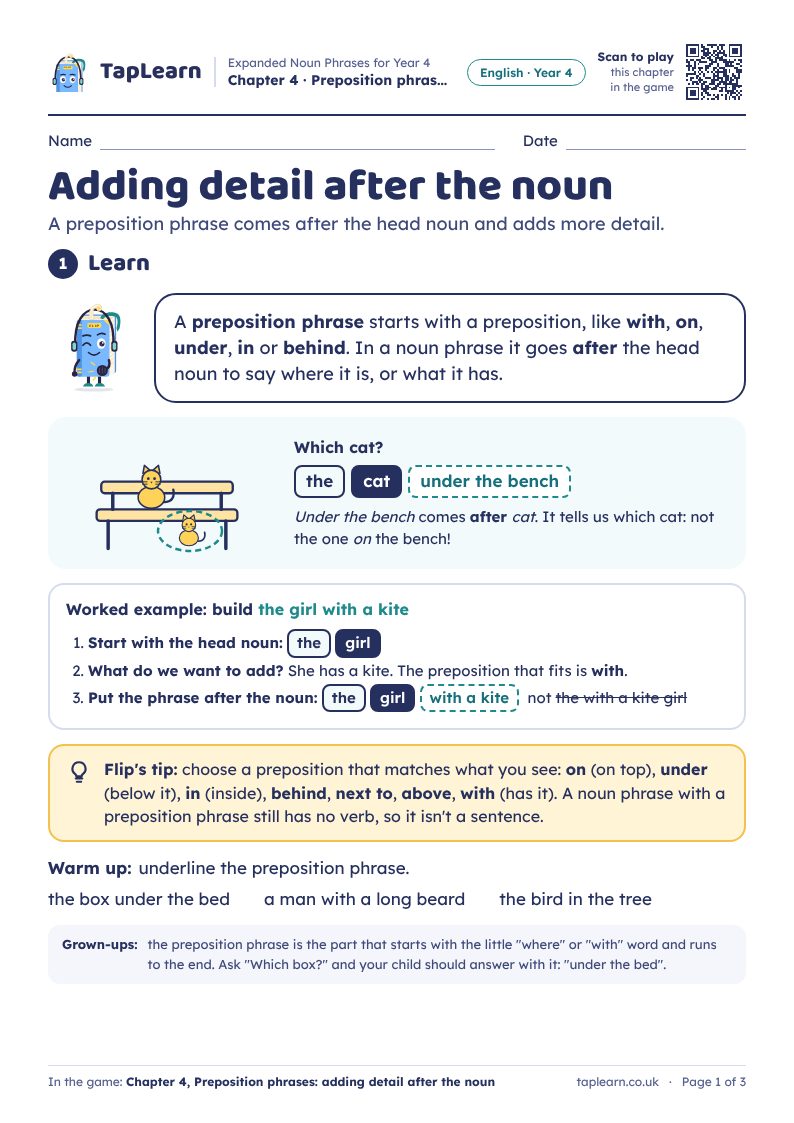
Adding Detail After the Noun is a printable preposition phrases worksheet for Year 4 (ages 8 to 9) that teaches children to put a phrase starting with a preposition like under or with after the head noun, as in "the girl with a kite". It covers the Year 4 statement on noun phrases expanded by the addition of modifying adjectives, nouns and preposition phrases.
This worksheet is for members
Membership opens every chapter of every game and every worksheet, for all your children.
See the plansAlready a member? Log in to print it.
Start with the free one: Find the head noun (chapter 1).
Print it on A4, in colour or black and white. Do it after the chapter, or before it to see what your child already knows.
What's on the worksheet
Your child adds a preposition phrase after a head noun, like the cat under the bench, chooses the preposition that matches a picture, and puts the phrase in the right place. Includes a hide-and-describe game and an answers sheet.
- Page 1 · Learn
- How "under the bench" tells us which cat, a worked example building "the girl with a kite", Flip's tip on matching prepositions, and an underline-the-preposition-phrase warm-up.
- Page 2 · Try it together
- Hide and describe: the grown-up hides a toy and gives a clue as a noun phrase, like "the teddy under the cushion", the child finds it, then swap using a different preposition each time.
- Page 3 · Practise
- Write prepositions to match a picture, fix phrases in the wrong place, add preposition phrases to match pictures, and a challenge about whether a noun phrase is a sentence.
- Answers sheet
- Every answer, mix-ups like "the under the bench cat", and which-one and preposition-swap ideas.
3 A4 pages and an answers sheet · about 25 minutes
Using it at home
- Ask "Which box?" and your child should answer with the preposition phrase: "under the bed".
- In hide and describe, give a clue with the wrong preposition, like "on the cushion" when it's underneath, and see if your child fixes it.
- At the park or in a picture book, ask "Which dog?" and answer with a preposition phrase: "the dog with the stick".
Watch out for
- Putting the phrase before the noun, like "the under the bench cat".
- It always comes after the head noun.
- Choosing a preposition that doesn't match, like on for something underneath.
- Point to the picture and ask, "Is it on top, underneath or inside?"
- Thinking the last noun is the head noun.
- In "the frog in the pond", it's a frog, not a pond.
Questions from the worksheet
- The preposition phrase is in the wrong place. Write each noun phrase the right way: the with a red door house; a on the wall clock; the in the pond frog.
- Underline the preposition phrase: the box under the bed; a man with a long beard; the bird in the tree.
- Ava wrote The dog under the table. She says it's a sentence because it has a capital letter and a full stop. Is she right? How could you make it into a sentence?
The answers are on the answers sheet, for grown-ups.
National curriculum in England
This worksheet practises this statement from the Year 4 english programme of study:
- Sentence: noun phrases expanded by the addition of modifying adjectives, nouns and preposition phrases (e.g. the teacher expanded to: the strict maths teacher with curly hair)
In the classroom
- Play preposition swap: change one word (the cat on, under, behind the bench) and pupils sketch the difference.
- Run hide and describe with a class toy as a starter.
Questions and answers
What is a preposition phrase?
A preposition phrase starts with a preposition, like with, on, under or behind, and adds detail such as where something is or what it has.
Where does a preposition phrase go in a noun phrase?
After the head noun: "the cat under the bench", not "the under the bench cat".
Is "The dog under the table." a sentence?
No. A capital letter and full stop don't make a sentence; it needs a verb: "The dog under the table barked."
 TapLearn