Modifying adjectives worksheet for Year 4: Adjectives before nouns
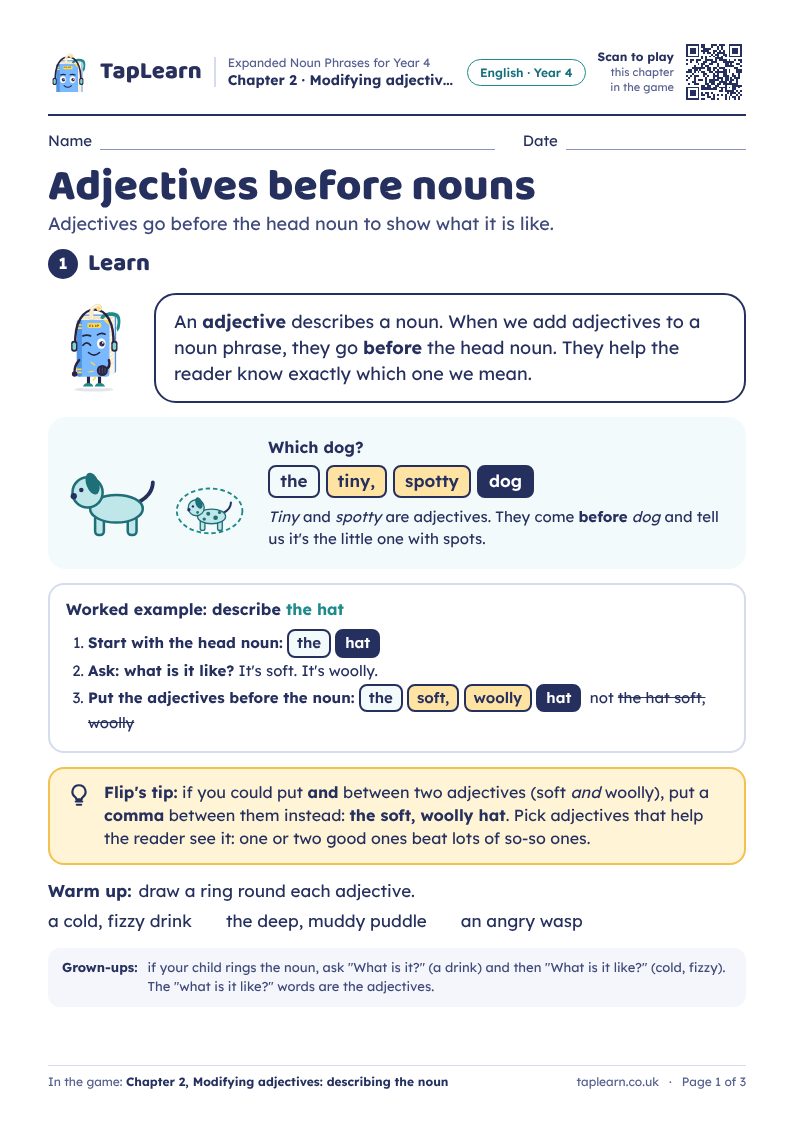
Adjectives Before Nouns is a printable modifying adjectives worksheet for Year 4 (ages 8 to 9) that teaches children to put adjectives before the head noun, as in "the tiny, spotty dog", with a comma between two adjectives you could join with and. It covers the Year 4 statement on noun phrases expanded by the addition of modifying adjectives, nouns and preposition phrases.
This worksheet is for members
Membership opens every chapter of every game and every worksheet, for all your children.
See the plansAlready a member? Log in to print it.
Start with the free one: Find the head noun (chapter 1).
Print it on A4, in colour or black and white. Do it after the chapter, or before it to see what your child already knows.
What's on the worksheet
Your child adds adjectives before a head noun to describe it, uses a comma between two adjectives, and chooses ones that help the reader picture it. Includes a 'Guess my thing' game and an answers sheet.
- Page 1 · Learn
- How adjectives show which dog we mean, a worked example describing a soft, woolly hat, Flip's tip on commas and choosing helpful adjectives, and a ring-the-adjectives warm-up.
- Page 2 · Try it together
- Guess my thing: the grown-up secretly picks something in the room and describes it with two adjectives before the noun, the child finds it, then swap and write each noun phrase.
- Page 3 · Practise
- Ring adjectives and underline head nouns, fix adjectives in the wrong place, write two adjectives for pictures, match noun phrases to vases, and a challenge about a puppy.
- Answers sheet
- Every answer, mix-ups like "the drink cold", and guess-my-pet and better-words ideas.
3 A4 pages and an answers sheet · about 25 minutes
Using it at home
- If your child rings the noun, ask "What is it?" (a drink), then "What is it like?" (cold, fizzy). The "what is it like?" words are the adjectives.
- In guess my thing, try an unhelpful adjective like "the nice cushion" and talk about why "soft, stripy" helps more.
- Swap a dull adjective like nice or big for a sharper one when you chat.
Watch out for
- Putting adjectives after the noun, like "the drink cold".
- In English, adjectives in a noun phrase go before the noun.
- Mixing up the adjective and the noun.
- Ask "What is it?" for the noun, then "What is it like?" for the adjectives.
- Putting commas in the wrong place.
- Put one between two adjectives you could join with and (soft, woolly). No comma before the noun.
Questions from the worksheet
- Draw a ring round each adjective. Underline the head noun: a crunchy, juicy apple; the grumpy, hungry goat; a brave, clever knight.
- These adjectives are in the wrong place. Write each noun phrase the right way: the drink cold; a jumper woolly; the path steep, rocky.
- Look at the vases. Write the letter of the vase each noun phrase describes: the short, round vase; the tall, round vase; the tall, thin vase.
- Mia wrote: the cute, little, tiny, small, happy, nice puppy. Is this a good noun phrase? How could she make it better?
The answers are on the answers sheet, for grown-ups.
National curriculum in England
This worksheet practises this statement from the Year 4 english programme of study:
- Sentence: noun phrases expanded by the addition of modifying adjectives, nouns and preposition phrases (e.g. the teacher expanded to: the strict maths teacher with curly hair)
In the classroom
- Play guess my thing with classroom objects as a starter.
- Use Practise D to discuss how adjectives pick out one thing.
Questions and answers
Where do adjectives go in a noun phrase?
Adjectives go before the head noun: "the tiny, spotty dog", not "the dog tiny, spotty".
When do you use a comma between adjectives?
Use a comma between two adjectives you could join with and: "the soft, woolly hat". Don't put a comma before the noun.
How many adjectives should children use?
One or two that each add something new help the reader more than lots of adjectives that mean the same.
 TapLearn