Carnivores, herbivores and omnivores worksheet for Year 1: Who eats what?
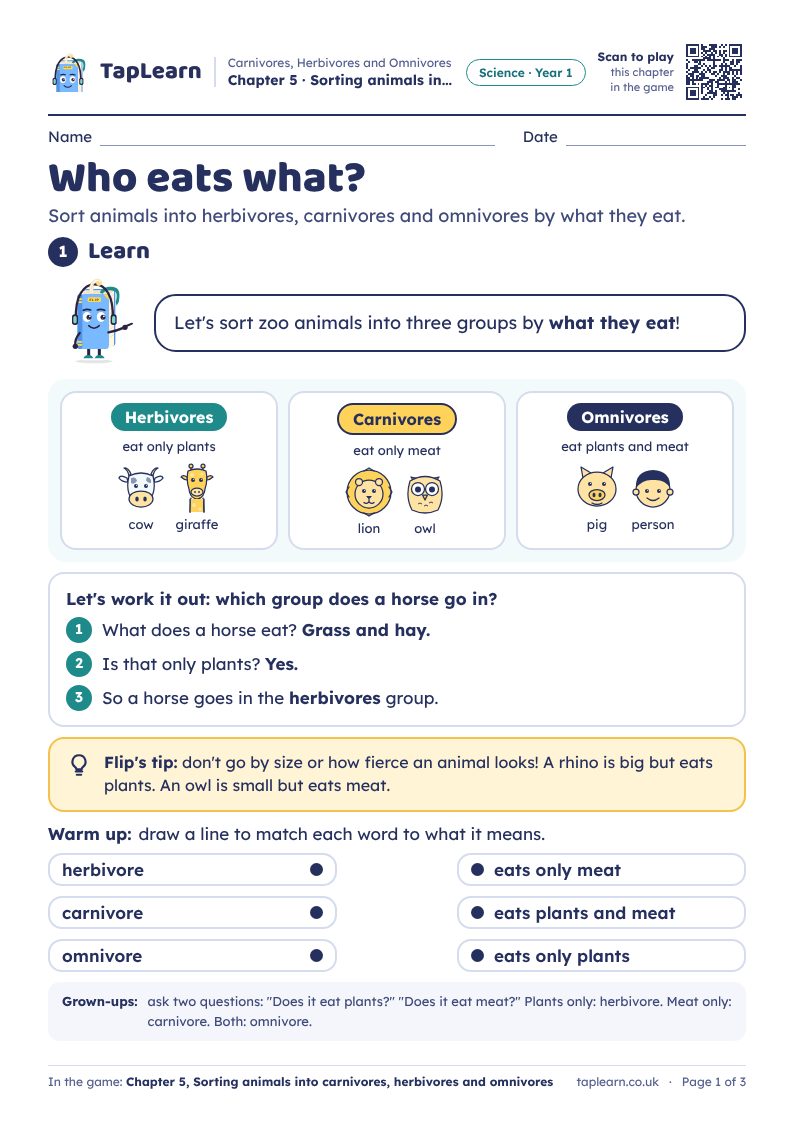
Who Eats What? is a printable carnivores, herbivores and omnivores worksheet for Year 1 (ages 5 to 6) that teaches children to sort common animals into the three groups and say what each eats. It follows the Year 1 national curriculum in England: identify and name a variety of common animals that are carnivores, herbivores and omnivores.
This worksheet is for members
Membership opens every chapter of every game and every worksheet, for all your children.
See the plansAlready a member? Log in to print it.
Start with the free one: Plant food and meat food (chapter 1).
Print it on A4, in colour or black and white. Do it after the chapter, or before it to see what your child already knows.
What's on the worksheet
Sort common animals into herbivores, carnivores and omnivores and say what each one eats. With a who eats what zoo game using toy animals or pictures, sorting, odd one out practice, and answers.
- Page 1 · Learn
- Flip sets up three zoo areas, herbivores, carnivores and omnivores, with two animals in each, then works out that a horse is a herbivore. A warm-up matches each word to what it means.
- Page 2 · Try it together
- Who eats what? Zoo: label three sheets of paper as zoo areas, put toy animals or pictures in the right one, say a food each eats, and record four animals.
- Pages 2–3 · Practise
- Write nine animals into a three-group table, ring the right group for six more, and find the odd one out in two rows. Then a challenge about whether frogs are herbivores.
- Answers sheet
- Every answer by page, what to watch out for (judging by size or how fierce an animal looks, mixing up the words) and quick ideas to go further.
3 A4 pages and an answers sheet · about 30 minutes
In the classroom
- Turn three corners of the room into zoo areas. Call out an animal and children walk to the right corner.
- Use the odd one out rows as a talk-partner starter, then ask pairs to make up their own row for the class.
Questions from the worksheet
- Write each animal's name in the right group: cow, lion, pig, rabbit, shark, bear, sheep, owl, chicken.
- Ring the right group for each animal: giraffe, cat, fox, frog, person, elephant.
- Odd one out! Ring the animal that is in a different group: cow, sheep, lion.
- Mia says, "Frogs are small and gentle, so they must be herbivores." Is she right? Why?
The answers are on the answers sheet, for grown-ups.
National curriculum in England
This worksheet practises this statement from the Year 1 science programme of study:
- Identify and name a variety of common animals that are carnivores, herbivores and omnivores
Source: National curriculum in England: science programmes of study (DfE)
Using it at home
- Ask two questions about each animal: "Does it eat plants?" and "Does it eat meat?" The answers tell you the group.
- Let your child copy animal names from the pictures in set A, or draw a tiny picture of each animal instead of writing.
Watch out for
- Thinking big or fierce-looking animals, like a rhino, must eat meat.
- Rhinos, elephants and hippos are big herbivores. Ask what it eats, not how it looks.
- Thinking small or gentle-looking animals, like an owl or a frog, must eat plants.
- Owls, frogs and cats are small carnivores: they catch and eat other animals.
- Mixing up the words carnivore, herbivore and omnivore.
- Herbivore: plants. Carnivore: meat. Omnivore: both. Say the word with its food each time.
Questions and answers
What is the difference between carnivores, herbivores and omnivores?
Herbivores eat only plants, carnivores eat only meat and omnivores eat both plants and meat. A cow is a herbivore, a lion is a carnivore and a pig is an omnivore.
How can children tell which group an animal is in?
Ask what the animal eats, not how it looks. If it eats only plants it is a herbivore, only meat a carnivore, and both an omnivore.
Is a bear a carnivore or an omnivore?
Most bears, such as brown bears, are omnivores: they eat berries, nuts and roots as well as fish and insects. Polar bears eat mostly meat.
 TapLearn