Herbivores worksheet for Year 1
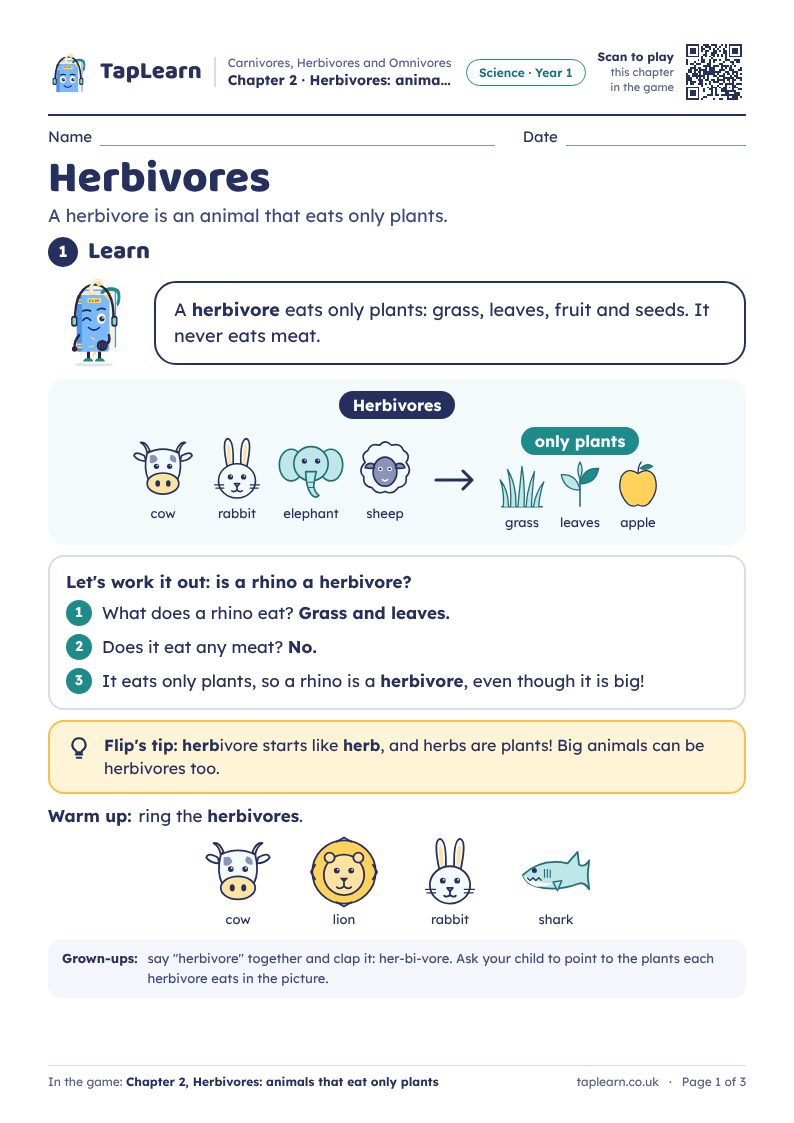
Herbivores is a printable herbivores worksheet for Year 1 (ages 5 to 6) that teaches children that a herbivore eats only plants and to name common herbivores such as cows, rabbits and elephants. It follows the Year 1 national curriculum in England: identify and name a variety of common animals that are carnivores, herbivores and omnivores.
This worksheet is for members
Membership opens every chapter of every game and every worksheet, for all your children.
See the plansAlready a member? Log in to print it.
Start with the free one: Plant food and meat food (chapter 1).
Print it on A4, in colour or black and white. Do it after the chapter, or before it to see what your child already knows.
What's on the worksheet
Learn that a herbivore eats only plants and name herbivores such as cows, rabbits and elephants, including big ones like rhinos. With a herbivore hunt in books or toys, matching, yes or no and drawing practice, and answers.
- Page 1 · Learn
- Flip introduces herbivores with a picture of a cow, rabbit, elephant and sheep eating only plants, then works out that a rhino is a herbivore even though it is big. A warm-up rings the herbivores.
- Page 2 · Try it together
- Herbivore hunt: look through an animal book, a farm book or toy animals, say "herbivore!" for each animal that eats only plants, and draw it with the plants it eats.
- Pages 2–3 · Practise
- Match a giraffe, rabbit and cow to plant food, ring yes or no for six animals, fill gaps, and draw a herbivore with its food. Then a challenge about whether rhinos eat meat.
- Answers sheet
- Every answer by page, what to watch out for (thinking big animals eat meat, mixing up the three words) and quick ideas to go further.
3 A4 pages and an answers sheet · about 25 minutes
In the classroom
- Start with the warm-up on the board: four animals, children point to the herbivores and say what each one eats.
- Use set B as a stand up, sit down game: stand for a herbivore, sit for any other animal.
Questions from the worksheet
- Draw a line from each herbivore to a plant it eats: giraffe, rabbit, cow.
- Is it a herbivore? Ring yes or no: horse, owl, sheep, cat, elephant, rhino.
- Fill the gap: A herbivore eats only ___.
- Draw a herbivore and the plant it eats.
- Leo says, "Rhinos are big and scary, so they must eat meat." Is he right? Why?
The answers are on the answers sheet, for grown-ups.
National curriculum in England
This worksheet practises this statement from the Year 1 science programme of study:
- Identify and name a variety of common animals that are carnivores, herbivores and omnivores
Source: National curriculum in England: science programmes of study (DfE)
Using it at home
- Use a farm or animal book you already have for the herbivore hunt. Let your child do the spotting and you do any writing.
- Clap the word her-bi-vore together and link it to herbs, which are plants. A short, silly way to remember it works best at this age.
Watch out for
- Thinking big or fierce-looking animals, like a rhino, must eat meat.
- Elephants, rhinos and hippos are huge herbivores. Ask, "What does it actually eat?" rather than how big it is.
- Mixing up the words carnivore, herbivore and omnivore.
- Link herbivore to herbs, which are plants, and use only this one word until it is secure.
Questions and answers
What is a herbivore?
A herbivore is an animal that eats only plants, such as grass, leaves, fruit and seeds. Cows, sheep, horses, rabbits, elephants and giraffes are herbivores.
Are big animals always meat eaters?
No. Some of the biggest land animals, like elephants, rhinos and hippos, are herbivores. You can't tell what an animal eats from its size.
 TapLearn