Two-way tables worksheet for Year 3
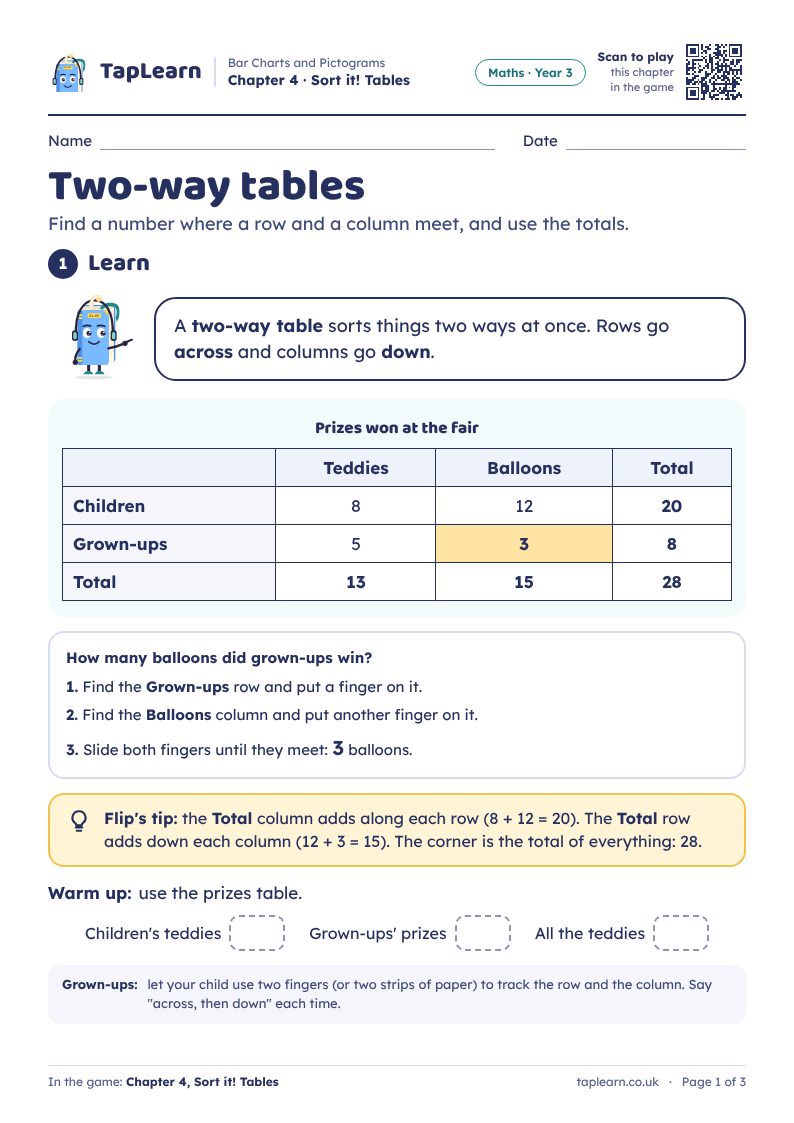
Two-Way Tables is a printable two-way tables worksheet for Year 3 (ages 7 to 8) that teaches children to find numbers where a row and a column meet, read totals and work out missing numbers. It covers the Year 3 maths statement to interpret and present data using bar charts, pictograms and tables.
This worksheet is for members
Membership opens every chapter of every game and every worksheet, for all your children.
See the plansAlready a member? Log in to print it.
Start with the free one: Tally marks (chapter 1).
Print it on A4, in colour or black and white. Do it after the chapter, or before it to see what your child already knows.
What's on the worksheet
Your child reads tables and two-way tables using rows, columns and totals, and works out missing numbers. Includes a shoe sort activity with the shoes by your door and an answers sheet.
- Page 1 · Learn
- A prizes table sorted by children and grown-ups, a worked example finding grown-ups' balloons with two fingers, Flip's tip on what the totals add, and a warm-up.
- Page 2 · Try it together
- Shoe sort: sort pairs of shoes into grown-ups' and children's, then with and without laces, write them in a two-way table and fill in the totals. Then answer questions on a games table.
- Page 3 · Practise
- Fill missing numbers in a cake stall table using totals, ring true or false statements, write and answer your own question, and a challenge about Year 3's hook-a-duck.
- Answers sheet
- Every answer, mix-ups like using a total as one group's number, and real-timetable and cutlery-sort ideas.
3 A4 pages and an answers sheet · about 25 minutes
Using it at home
- Let your child use two fingers or two strips of paper to track the row and the column, saying "across, then down" each time.
- After the shoe sort, ask one question for each part of the table, such as "How many pairs altogether?"
- Look at a bus timetable or school dinner menu together and find where a row meets a column.
Watch out for
- Reading from the wrong row or column.
- Use two fingers or a ruler on each, and say "across, then down".
- Mixing up totals with the other numbers.
- Ask "Is this number for one group, or for everyone?"
- Adding the two numbers you can see to find a missing part.
- If the total is 20 and one part is 12, the missing part is 20 − 12 = 8.
Questions from the worksheet
- Use the table: how many in Year 4 played hoopla?
- The cake stall's table has missing numbers. Use the totals to fill them in.
- True or false? Altogether, more children played hoopla than hook-a-duck.
- Leo looks at the games table and says, "25 children in Year 3 played hook-a-duck." Is he right? Where did his 25 come from?
The answers are on the answers sheet, for grown-ups.
National curriculum in England
This worksheet practises these statements from the Year 3 maths programme of study:
- Interpret and present data using bar charts, pictograms and tables
- Solve one-step and two-step questions using information presented in scaled bar charts and pictograms and tables
Source: National curriculum in England: mathematics programmes of study (DfE)
In the classroom
- Build a class two-way table of school dinners and packed lunches by girls and boys, then fill the totals together.
- Use Practise C as a true or false vote with thumbs up and down.
Questions and answers
What is a two-way table?
A two-way table sorts things two ways at once, with rows going across and columns going down. Each number sits where a row and a column meet.
What do the totals in a two-way table show?
The total column adds along each row, the total row adds down each column, and the corner is the total of everything.
How do you find a missing number in a table?
Use the total. If a row's total is 20 and one part is 12, the missing part is 20 − 12 = 8.
 TapLearn