French Numbers and Colours: Coco's Fairground Adventure
Learn French numbers and colours, from un to vingt and rouge to gris, then say real French sentences with Coco the parrot at a fairground.
Online game, chapter 1 free · Years 3 and 4 (KS2) · ages 7–9 · national curriculum in England · no adverts · plays on a phone, tablet or computer · no sign-up to start.
An online languages game for Years 3 and 4 (KS2). It covers the national curriculum in England, Years 3–6 languages: “Develop accurate pronunciation and intonation so that others understand when they are reading aloud or using familiar words and phrases”, and 1 more statement listed under the chapters.
5 short chapters, about 40 minutes in all. Children can stop after any chapter.
Start playing for free. Plays in the browser on phones, tablets and computers: no app, no adverts.
Free for teachers: every chapter on the whiteboard with a free teacher account.
Last updated · Checked against the national curriculum in England by the TapLearn team
What you'll learn
Count from un to vingt with clear French pronunciation
Name 11 colours in French, including tricky blanc, rose and marron
Spot silent letters at the end of words like deux and vert
Make your voice go up when asking a question in French
Say your age with J'ai … ans instead of je suis
Put the colour after the thing: un ballon rouge
Chapter by chapter
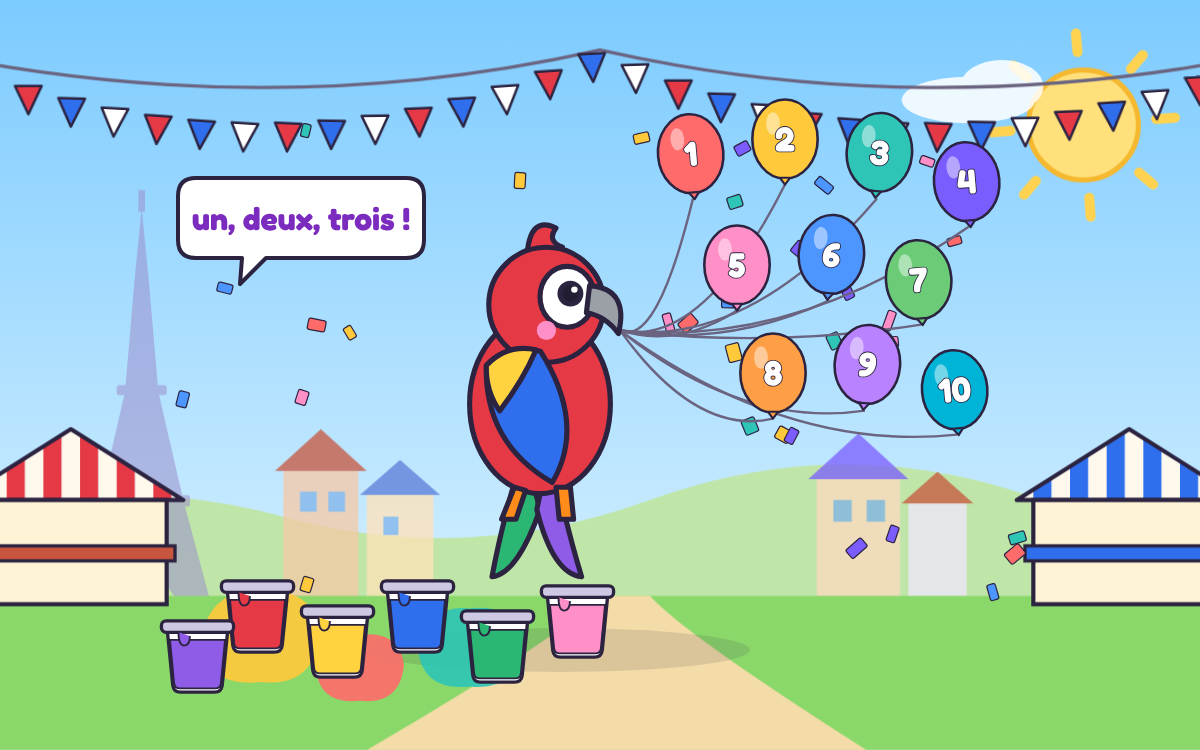
Count from 1 to 10 in FrenchStart playing for free
Years 3–6 languages · 1
Count from 11 to 20 in French
Years 3–6 languages · 1
Name 11 colours in French
Years 3–6 languages · 1
Say French words clearly: silent letters and the question tune
Years 3–6 languages · 1
Say short sentences with numbers and colours (age, colour, how many)
Years 3–6 languages · 2Years 3–6 languages · 1
Grand Challenge: numbers, colours and sentences (10 questions)
What the chapters cover in the national curriculum in England:
Years 3–6 languages: Develop accurate pronunciation and intonation so that others understand when they are reading aloud or using familiar words and phrases
Years 3–6 languages: Speak in sentences, using familiar vocabulary, phrases and basic language structures
About this adventure
French Numbers and Colours is an interactive game that teaches children aged 7–9 to count to 20, name 11 colours and say short sentences in French. It follows the Year 3 KS2 languages curriculum.
Players pop balloons, ride a big wheel and paint a parrot back to colour while hearing every French word spoken aloud. They learn the pattern behind the teen numbers, where dix-sept means ten and seven. They also learn which letters are silent, like the x in deux, and which end sounds are spoken, like the k sound in cinq.
At the puppet show, children build sentences such as J'ai huit ans (I am eight), C'est rouge (it's red) and Il y a trois ballons (there are three balloons). They practise putting the colour after the thing, as in un ballon rouge. A 10-question challenge checks everything at the end.
Questions and answers
How do you count to 20 in French?
The numbers are un, deux, trois, quatre, cinq, six, sept, huit, neuf, dix, onze, douze, treize, quatorze, quinze, seize, dix-sept, dix-huit, dix-neuf and vingt. From 17 to 19, French simply joins ten and the small number, so dix-sept means ten and seven.
Why are some letters silent in French numbers?
Most consonants at the end of a French word are not pronounced. That is why deux sounds like duh and vingt sounds like van. Some numbers keep their last sound, though: cinq, sept, huit and neuf all end with a spoken consonant.
How do you say how old you are in French?
You say J'ai, then your number, then ans, for example J'ai huit ans. It literally means I have eight years. English speakers often say je suis huit by mistake, but French uses have rather than am for age.
What age is this French numbers and colours game for?
It is designed for children aged 7 to 9, matching Year 3 French in KS2, and suits Year 4 learners who need a refresher. Every French word is read aloud, so children who are still building reading confidence can follow along easily.
What does the game include and how long does it take?
There are five chapters covering numbers to 10, numbers to 20, colours, French sounds and short sentences, plus a 10-question challenge. Playing everything takes about 40 minutes, and each chapter can be played on its own in one short sitting.
We count visits to make TapLearn better.We use one cookie, only on this site, to see how families find and use it. No adverts, and nothing is shared.One cookie, only on this site. No adverts.How we measure
 TapLearn