Spelling ou words worksheet for Years 3–4: Spelling with ou
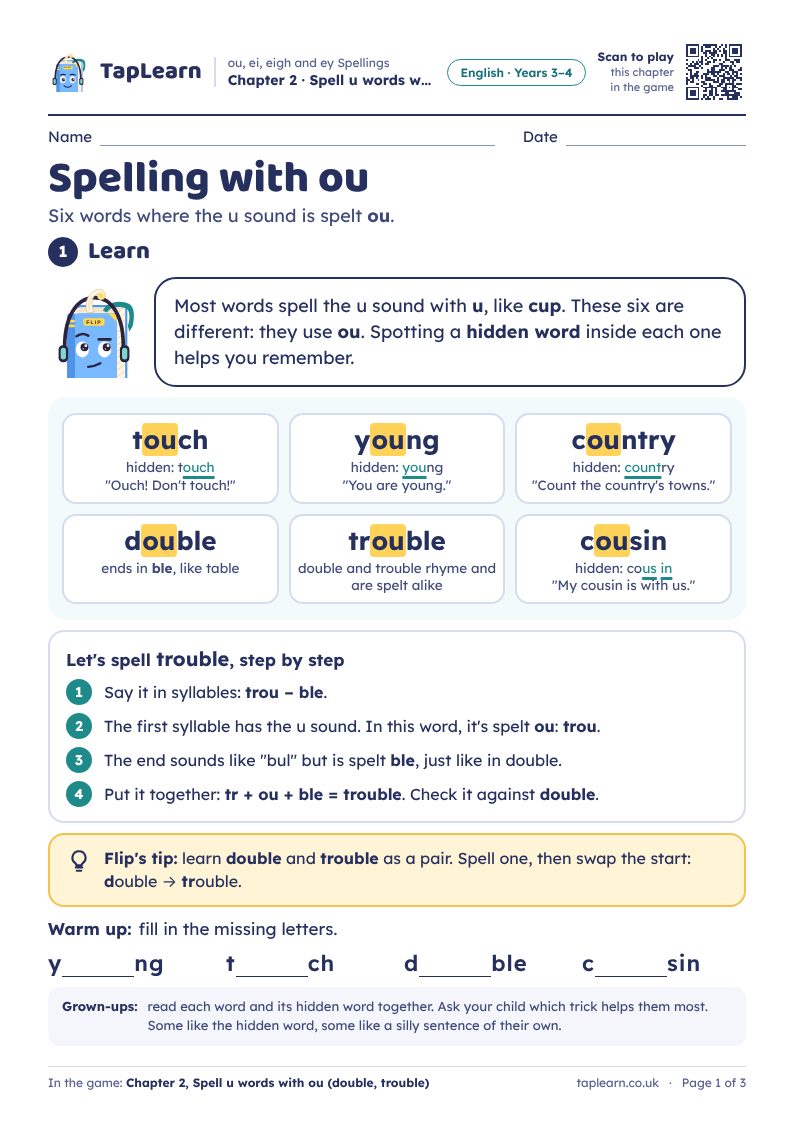
Spelling with ou is a printable spelling ou words worksheet for Years 3 and 4 (ages 7 to 9) that teaches six words where the u sound is spelt ou, young, touch, double, trouble, country and cousin, using hidden words like ouch in touch. It covers the Years 3 to 4 spelling of the u sound spelt ou.
This worksheet is for members
Membership opens every chapter of every game and every worksheet, for all your children.
See the plansAlready a member? Log in to print it.
Start with the free one: When ou says u (chapter 1).
Print it on A4, in colour or black and white. Do it after the chapter, or before it to see what your child already knows.
What's on the worksheet
Your child practises spelling young, touch, double, trouble, country and cousin, using hidden words and word sums to remember the ou. Includes a hide-and-seek words activity and an answers sheet.
- Page 1 · Learn
- The six words with a hidden word or trick for each, a worked example spelling trouble, Flip's tip to learn double and trouble as a pair, and a missing-letters warm-up.
- Page 2 · Try it together
- Hide-and-seek words: the grown-up hides the six words on scraps around a room, the child finds each one, reads it, says its trick, then writes it from memory and checks.
- Page 3 · Practise
- Ring the correct spelling, join word sums, fill gaps with the six words, write a sentence using two of them, and a challenge about dubble.
- Answers sheet
- Every answer, mix-ups like tuch and dobble, and spell-it-aloud ideas plus more ou words.
3 A4 pages and an answers sheet · about 20 minutes
Using it at home
- Read each word and its hidden word together and ask which trick helps most. Some children prefer a silly sentence of their own.
- In hide-and-seek, if a word isn't right, don't rub it out: look at the scrap together, find the different letters and try once more beside it.
- Take turns spelling the six words aloud; the listener says "ou!" when they hear o-u.
Watch out for
- Writing u instead of ou, like tuch or yung.
- The sound is u, so it's a sensible guess. Praise the listening, then show the ou and its hidden word.
- Writing o instead of ou, like dobble or contry.
- Remind them the u sound in these words needs both letters: o and u.
- Writing -bel instead of -ble, like doubel.
- Point to the ble ending in table, bubble and double.
Questions from the worksheet
- Draw a ring round the word that is spelt correctly: tuch / touch / toch; dobble / duble / double; cuntry / country / contry.
- Word sums. Join the parts and write the whole word: d + ou + ble, tr + ou + ble, you + ng, count + ry, c + ou + sin.
- Fill each gap with a word from the box (young, touch, double, trouble, country, cousin): My aunt's son is my ___. Wales is a ___ next to England.
- Ava wrote: "I got a dubble six!" She says double has a u sound, so it should have a u. What would you tell her?
The answers are on the answers sheet, for grown-ups.
National curriculum in England
This worksheet practises this statement from the Years 3–4 english programme of study:
- The /ʌ/ sound spelt ou
In the classroom
- Display the six words with their hidden-word tricks.
- Use Practise A as a quick spelling check on mini whiteboards.
Questions and answers
How do you spell touch?
Touch is spelt t-o-u-c-h. A trick: "Ouch! Don't touch!" There's ouch hidden inside.
Why is double spelt with ou?
In a few words the u sound is spelt ou. Double and trouble rhyme and end the same way, so learn them as a pair.
Which words have the u sound spelt ou?
Year 3 and 4 words include young, touch, double, trouble, country and cousin; keen spellers can try couple, enough and tough.
 TapLearn