Negative temperatures worksheet for Year 4: Below freezing
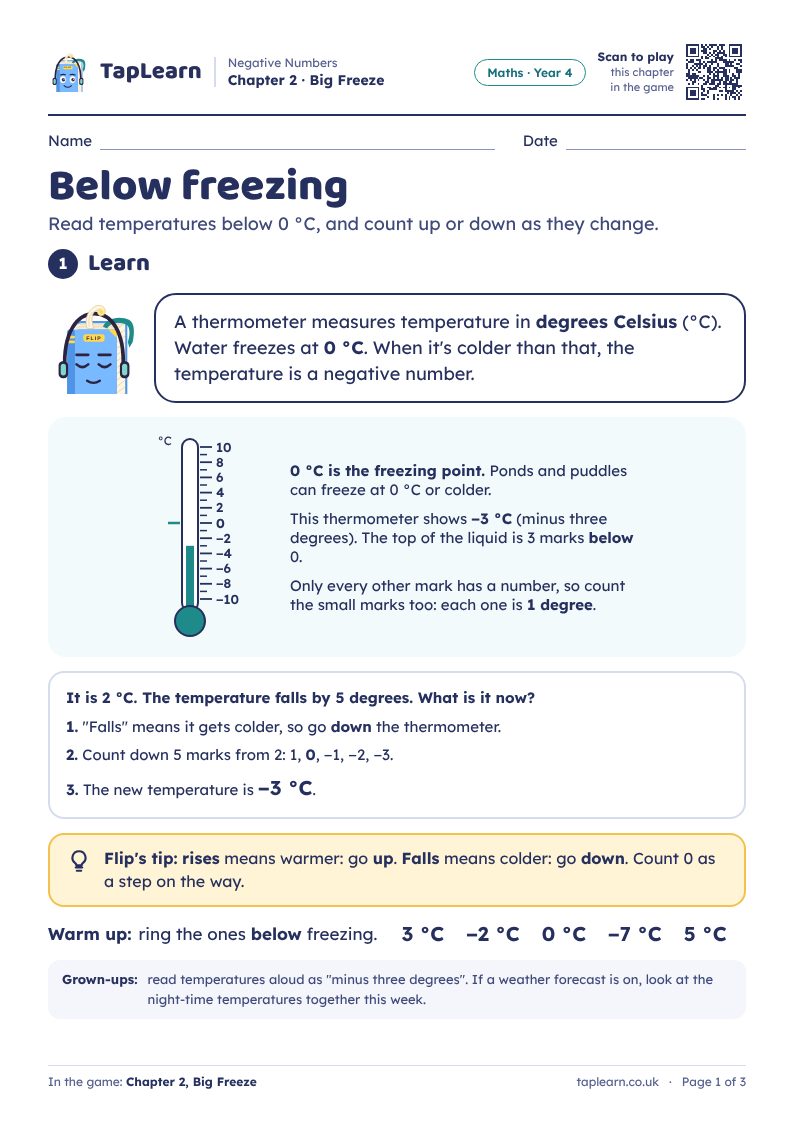
Below Freezing is a printable negative temperatures worksheet for Year 4 (ages 8 to 9) that teaches children to read thermometers below 0 °C and count up or down when the temperature rises or falls. It covers the Year 4 maths statement to count backwards through 0 to include negative numbers, here using temperatures.
This worksheet is for members
Membership opens every chapter of every game and every worksheet, for all your children.
See the plansAlready a member? Log in to print it.
Start with the free one: Counting through zero (chapter 1).
Print it on A4, in colour or black and white. Do it after the chapter, or before it to see what your child already knows.
What's on the worksheet
Your child reads temperatures below 0 °C on a thermometer and works out new temperatures when it rises or falls. Includes a paper thermometer activity and an answers sheet.
- Page 1 · Learn
- A thermometer showing −3 °C, why water freezes at 0 °C, how to count the unnumbered marks, a worked example of 2 °C falling by 5, Flip's tip on rises and falls, and a warm-up.
- Page 2 · Try it together
- Paper thermometer: mark a strip of card from −10 to 10, clip a paper clip on a start temperature, then slide it up or down as the grown-up says how much it rises or falls.
- Page 3 · Practise
- Work out new temperatures after rises and falls, read thermometers, answer questions about Ava's night-time temperatures, and a challenge about a rise from −2 °C.
- Answers sheet
- Every answer, mix-ups like going the wrong way or misreading by one degree, and forecast-watch and up-and-down ideas.
3 A4 pages and an answers sheet · about 25 minutes
In the classroom
- Make paper thermometers in pairs and take turns giving rise and fall challenges.
- Use a real weather forecast as a starter: which places are below freezing tonight?
Questions from the worksheet
- Rises and falls. Write the new temperature: 3 °C falls by 5, −4 °C rises by 6, −1 °C falls by 3, 0 °C falls by 8.
- Ava wrote down the night-time temperature each day. Which nights were below freezing? Which night was the coldest?
- It is −2 °C. The temperature rises by 3 degrees. Mia says, "Now it's −5 °C." Is she right? Explain.
The answers are on the answers sheet, for grown-ups.
National curriculum in England
This worksheet practises this statement from the Year 4 maths programme of study:
- Count backwards through 0 to include negative numbers
Source: National curriculum in England: mathematics programmes of study (DfE)
Using it at home
- Read temperatures aloud as "minus three degrees", and look at the night-time temperatures in a weather forecast together this week.
- With the paper thermometer, ask "Is it warmer or colder now? Did we go past freezing?"
- Ask quick questions in the car: "It's 1 °C and falls by 4. What now?" Then let your child ask you one.
Watch out for
- Going the wrong way when it rises or falls.
- Rises means up and warmer, falls means down and colder. Point up or down before counting.
- Misreading the thermometer by one degree.
- Only every other mark is numbered, so count the small marks from the nearest number.
- Dropping the minus sign or skipping 0 °C.
- Ask "Is it above or below freezing?" and count 0 °C as a step.
Questions and answers
What does a negative temperature mean?
A negative temperature is colder than 0 °C, the freezing point of water. −3 °C is read as minus three degrees.
At what temperature does water freeze?
Water freezes at 0 °C, so ponds and puddles can freeze at 0 °C or colder.
How do you work out a temperature change through zero?
Rises means count up and falls means count down, one degree at a time, counting 0 as a step. 2 °C falling by 5 is −3 °C.
 TapLearn