Changes in a food chain worksheet for Year 2: What if a link goes?
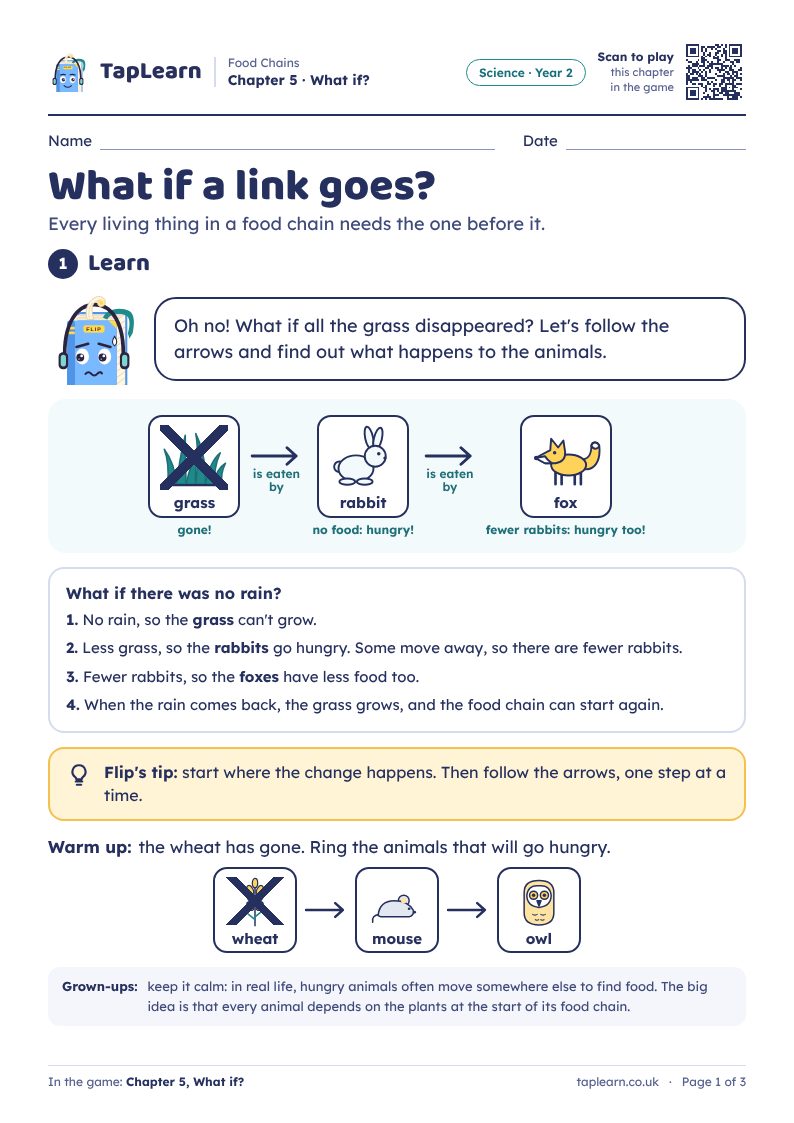
What If a Link Goes? is a printable food chains worksheet for Year 2 (ages 6 to 7) that teaches children to follow the arrows and explain what happens to the rest of a food chain when one part disappears. It covers the Year 2 science national curriculum statement: describe how animals obtain their food from plants and other animals, using the idea of a simple food chain.
This worksheet is for members
Membership opens every chapter of every game and every worksheet, for all your children.
See the plansAlready a member? Log in to print it.
Start with the free one: Plants make food (chapter 1).
Print it on A4, in colour or black and white. Do it after the chapter, or before it to see what your child already knows.
What's on the worksheet
Explain what happens to the rest of a food chain when one part disappears, following the arrows step by step. With a food chain tower to build and topple, and answers.
- Page 1 · Learn
- What happens to rabbits and foxes if the grass disappears, and a step-by-step example of what happens when there is no rain. Warm-up: the wheat has gone, so who goes hungry?
- Page 2 · Try it together
- Food chain tower: label and stack cups as grass, rabbit and fox, pull out the grass and watch the tower fall, then lift off the fox and talk about the rabbits.
- Page 3 · Practise
- Match changes to what happens next, answer questions about caterpillars vanishing from an oak tree, a true or false quiz, what if the foxes went, and Leo's owl challenge.
- Answers sheet
- All answers, three things to watch for, and what-if and garden helper talk ideas.
3 A4 pages and an answers sheet · about 20 minutes
Using it at home
- Keep it calm: in real life hungry animals often move somewhere else, and plants grow back when the rain returns.
- When your child names one animal that is affected, ask "And then what?" until you reach the end of the chain.
Watch out for
- Only looking one step along the chain.
- Ask "And then what?" until you reach the end of the chain.
- Thinking predators don't need plants.
- A fox never eats grass, but without grass there would be no rabbits for it.
- Worrying about the animals.
- Hungry animals often move to find food, and plants grow back when the rain returns.
Questions from the worksheet
- All the caterpillars have gone from the oak tree. Who will go hungry first? Who will go hungry next?
- True or false? If the grass goes, the foxes will be fine, because foxes don't eat grass.
- What if all the foxes went away? What might happen to the rabbits and the grass?
- Leo says, "Owls don't eat wheat. So if all the wheat disappeared, the owls would be fine." Is he right? Why?
The answers are on the answers sheet, for grown-ups.
National curriculum in England
This worksheet practises this statement from the Year 2 science programme of study:
- Describe how animals obtain their food from plants and other animals, using the idea of a simple food chain, and identify and name different sources of food
Source: National curriculum in England: science programmes of study (DfE)
In the classroom
- Build a food chain tower at the front and let pupils predict what will happen before removing each layer.
- What if? plenary: pairs pick a change, like no sun or no snails, and follow the chain together.
Questions and answers
What happens if one part of a food chain disappears?
Every animal in a food chain depends on the one before it, so a change affects the rest. If the grass disappears, rabbits go hungry, and then foxes have less food too.
Why does every food chain need plants?
Plants make the food that starts every food chain. Without plants, plant-eaters have nothing to eat, and the animals that eat them go hungry too.
 TapLearn