Cial and tial exceptions worksheet for Years 5–6: The rule-breakers
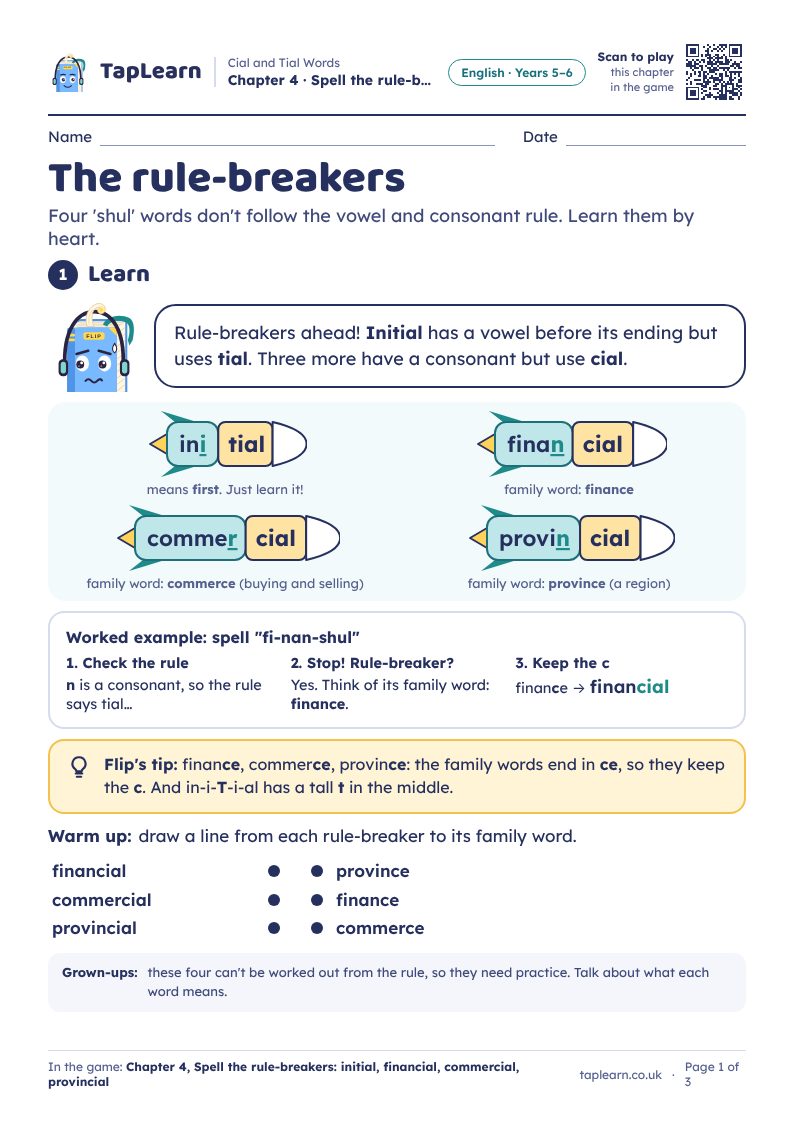
The Rule-breakers is a printable cial and tial exceptions worksheet for Years 5 and 6 (ages 9 to 11) that teaches the four 'shul' words that break the vowel and consonant rule: initial, and financial, commercial and provincial, which keep the c from finance, commerce and province. It covers the Years 5 to 6 spelling of endings that sound like 'shul', spelt -cial or -tial.
This worksheet is for members
Membership opens every chapter of every game and every worksheet, for all your children.
See the plansAlready a member? Log in to print it.
Start with the free one: The 'shul' sound (chapter 1).
Print it on A4, in colour or black and white. Do it after the chapter, or before it to see what your child already knows.
What's on the worksheet
Your child learns the four exceptions initial, financial, commercial and provincial, linking the last three to finance, commerce and province. Includes a family pairs memory game and an answers sheet.
- Page 1 · Learn
- The four rule-breakers with their meanings or family words, a worked example spelling financial, Flip's tip on ce family words and the tall t in initial, and a match-the-family-word warm-up.
- Page 2 · Try it together
- Family pairs: write the four rule-breakers and first, finance, commerce and province on scraps, play pairs face down, spell each rule-breaker you match, then make a silly sentence with all four.
- Page 3 · Practise
- Write ti or ci in each rule-breaker, correct rule-following misspellings, fill gaps with the right rule-breaker, sort words into rule and rule-breakers, and a challenge about inicial.
- Answers sheet
- Every answer, mix-ups like finantial, and family-call and initial-spotting ideas.
3 A4 pages and an answers sheet · about 25 minutes
Using it at home
- These four can't be worked out from the rule, so they need practice. Talk about what each word means.
- In family pairs, ask your child to say the family word first when spelling a rule-breaker: "finance, so financial with a c".
- Say everyone's initials at home, then spell "initial" out loud.
Watch out for
- Using the rule on the rule-breakers, like inicial or finantial.
- Praise the thinking, then say, "This one's a rule-breaker. What's its family word?"
- Writing the sound, like finanshal.
- We hear 'shul' but write cial.
- Forgetting which is which.
- Only initial uses tial. The three with a family word ending in ce use cial.
Questions from the worksheet
- Write ti or ci to finish each rule-breaker: ini_al, finan_al, commer_al, provin_al.
- These spellings follow the rule, but they're rule-breakers! Write each one correctly: inicial, finantial, commertial, provintial.
- Write the right rule-breaker in each gap: A ___ rocket carries passengers who pay for a ticket.
- Sort the words: do they follow the rule, or break it? special, initial, essential, financial, social, commercial, partial, provincial.
- Leo says, "Initial has an i before the ending. That's a vowel, so it must be inicial." Is Leo right? What would you tell him?
The answers are on the answers sheet, for grown-ups.
National curriculum in England
This worksheet practises this statement from the Years 5–6 english programme of study:
- Endings which sound like /ʃəl/ (–cial, –tial)
In the classroom
- Play family pairs in small groups.
- Use Practise D as a two-column card sort.
Questions and answers
Which cial and tial words break the rule?
The common exceptions are initial (vowel before, but -tial) and financial, commercial and provincial (consonant before, but -cial).
How can children remember financial?
Think of its family word, finance. Finance ends in ce, so financial keeps the c.
How do you spell initial?
Initial is i-n-i-t-i-a-l. A trick: in-i-T-i-al has a tall t in the middle.
 TapLearn