What you'll learn
- The Earth's four layers: crust, mantle, outer core and inner core
- How stuck tectonic plates suddenly slip and cause an earthquake
- The difference between the focus and the epicentre
- Why most earthquakes happen along plate boundaries and the Ring of Fire
- How a seismometer records shaking and what magnitude means
- How Drop, Cover and Hold On and safe buildings protect people
Chapter by chapter
- What is an earthquake? Earth's layers and tectonic plates Free to try
Years 3–6 geography · 1
- Why earthquakes happen: plates, faults and epicentres
Years 3–6 geography · 1
- Where earthquakes happen: plate boundaries and the Ring of Fire
Years 3–6 geography · 1
- Measuring earthquakes: seismometers and magnitude
Years 3–6 geography · 1
- How people prepare: drills, emergency kits and safe buildings
Years 3–6 geography · 1
- Earthquake Expert Challenge (10 questions)
What the chapters cover in the national curriculum in England:
- Years 3–6 geography: Describe and understand key aspects of physical geography, including: climate zones, biomes and vegetation belts, rivers, mountains, volcanoes and earthquakes, and the water cycle
About this adventure
Earthquake Explorers is an interactive geography game that teaches children aged 8–11 about earthquakes: why they happen, where in the world they strike and how people prepare for them. It follows the KS2 geography curriculum and is pitched mainly at Year 4.
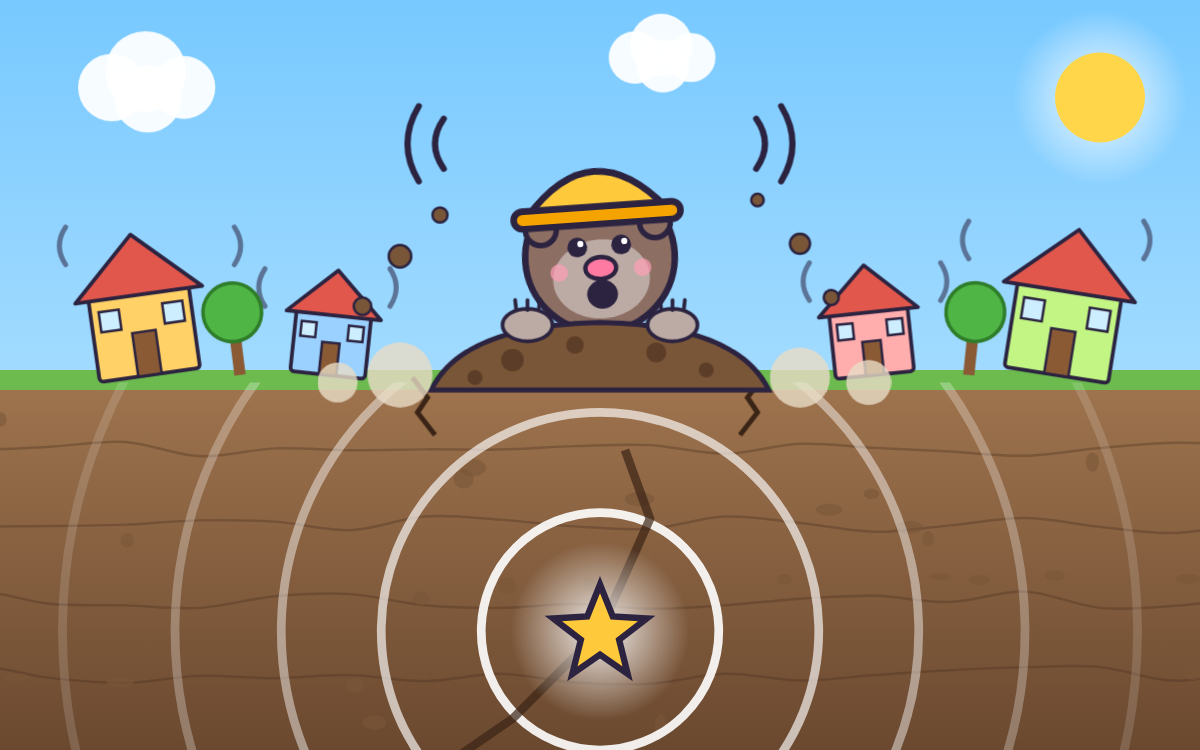
Guided by Pip the mole, children cut the Earth in half to name the crust, mantle, outer core and inner core, then push two tectonic plates until they stick and suddenly slip. They find the focus underground and the epicentre right above it, plot real earthquake patterns along plate boundaries and trace the Ring of Fire around the Pacific Ocean.
Later they read a seismometer's wiggly seismogram, turn a magnitude dial to see what a stronger earthquake does to a town, practise Drop, Cover and Hold On, pack an emergency kit and add cross braces and rubber pads to a building before shaking it.
Questions and answers
What causes an earthquake, in simple words?
An earthquake happens when two tectonic plates get stuck, pressure builds up, and then the rocks suddenly slip. The stored-up energy spreads out through the ground as seismic waves, which make the surface shake.
Where do most earthquakes happen?
Most earthquakes happen along plate boundaries, where tectonic plates meet. About nine out of ten happen around the Pacific Ocean on the Ring of Fire, in countries such as Japan, Indonesia, Chile and New Zealand. The UK is far from a boundary, so its earthquakes are usually small.
What should you do if an earthquake starts?
Drop, Cover and Hold On: get down on your hands and knees, crawl under a sturdy table to protect your head and neck, and hold on until the shaking stops. Standing in a doorway or running outside while the ground shakes is not safe.
What age is this earthquake game for?
The game is made for children aged 8 to 11 and matches the KS2 geography curriculum, where earthquakes are usually taught in Year 4. Younger children can enjoy it with a grown-up, as every instruction is read aloud.
What does the earthquake game include and how long does it take?
It has five chapters, each with an animated introduction, hands-on activities and a short recap, followed by a ten-question Earthquake Expert Challenge. Playing everything takes about 45 minutes, and children can choose any chapter or stop and carry on later.

 TapLearn